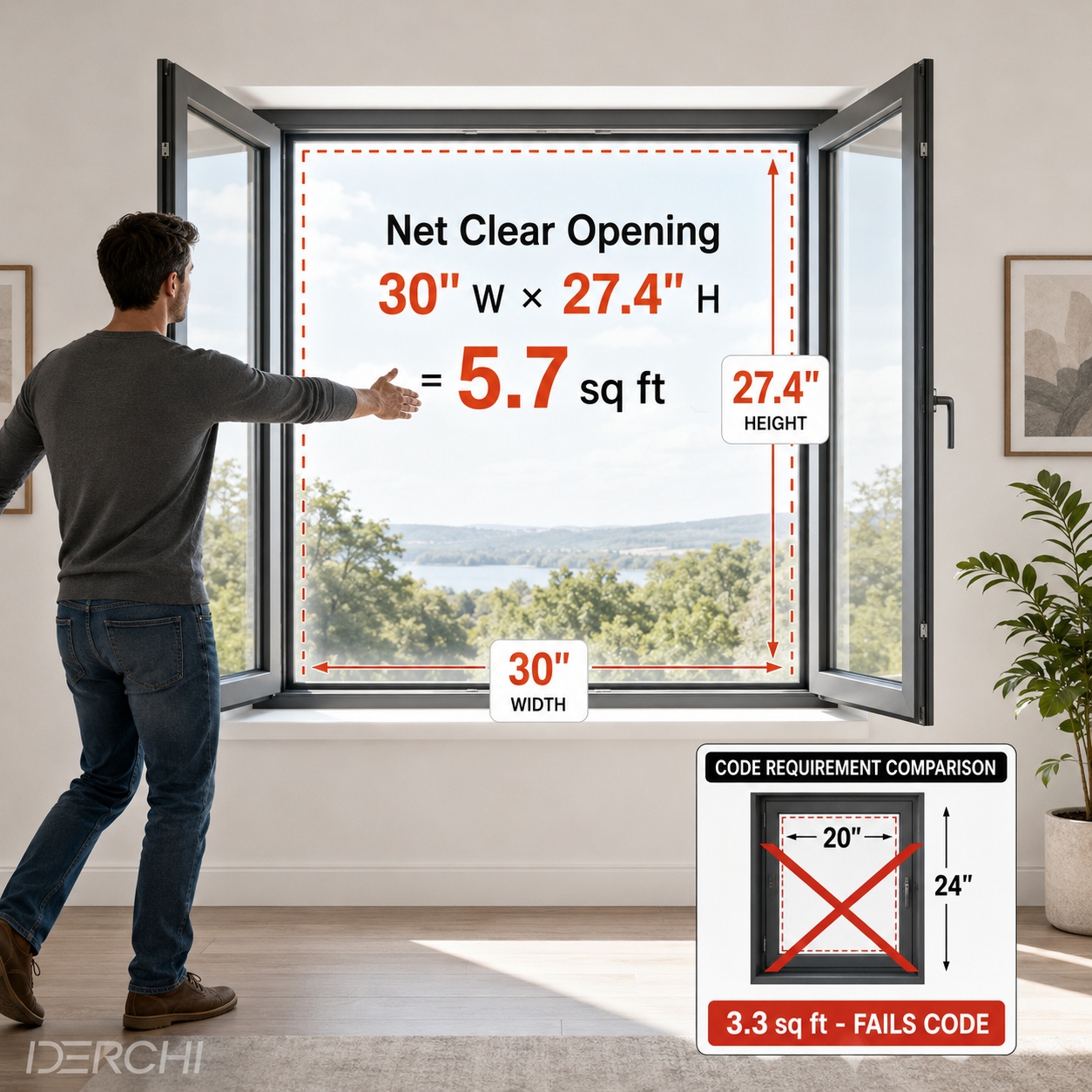
You’ve heard the term “5.7 square foot window” in building codes. But how big does that actually look on a wall? Many homeowners picture a modest opening, only to discover their existing frame falls far short of what the law demands.
That magic number—5.7 square feet—comes directly from the International Residential Code. It is the minimum net clear opening required for an emergency escape window in any above-grade sleeping room. The rule exists for one simple reason: in a fire, a person must be able to climb out, and a fully equipped firefighter must be able to enter. Yet a common mistake trips up builders and renovators alike. A 20-inch by 24-inch opening sounds close to code, but it actually yields just 3.3 square feet of clear space. That window would fail inspection.
In this guide, you’ll learn exactly how big a 5.7 sq ft window is in real dimensions you can measure on your own home. We’ll break down the math behind net clear opening versus frame size, show you which standard window styles can actually hit the mark, and explain the basement exception that sometimes allows a 5.0 square foot opening. If you are planning a bedroom renovation or finishing a basement, understanding these rules before you order can save you thousands. For those seeking code-compliant solutions tailored to a specific opening, DERCHI manufactures custom aluminum windows that can be configured to meet precise egress dimensions without major structural changes.
What Is a 5.7 Square Foot Window? The Egress Window Rule Explained
An egress window is simply an opening you can use to escape during an emergency. It’s not a specific style like a double‑hung or casement. It’s any operable window that gives you a safe, clear path out of a room when seconds count. Building codes require these openings so that both occupants and firefighters can move through them quickly.
You’ll most often hear about the 5.7 sq ft rule when you’re dealing with a bedroom. The International Residential Code says every sleeping room above grade needs at least one emergency escape window unless the room already has a door leading directly outside. Basement bedrooms and converted attics fall under similar rules, though below‑grade openings may get a small break on the total area.
To pass inspection, a window must hit four numbers at the same time. Here is what the IRC asks for:
Minimum clear opening width: 20 inches
Minimum clear opening height: 24 inches
Minimum net clear opening area: 5.7 square feet
Maximum sill height above the floor: 44 inches
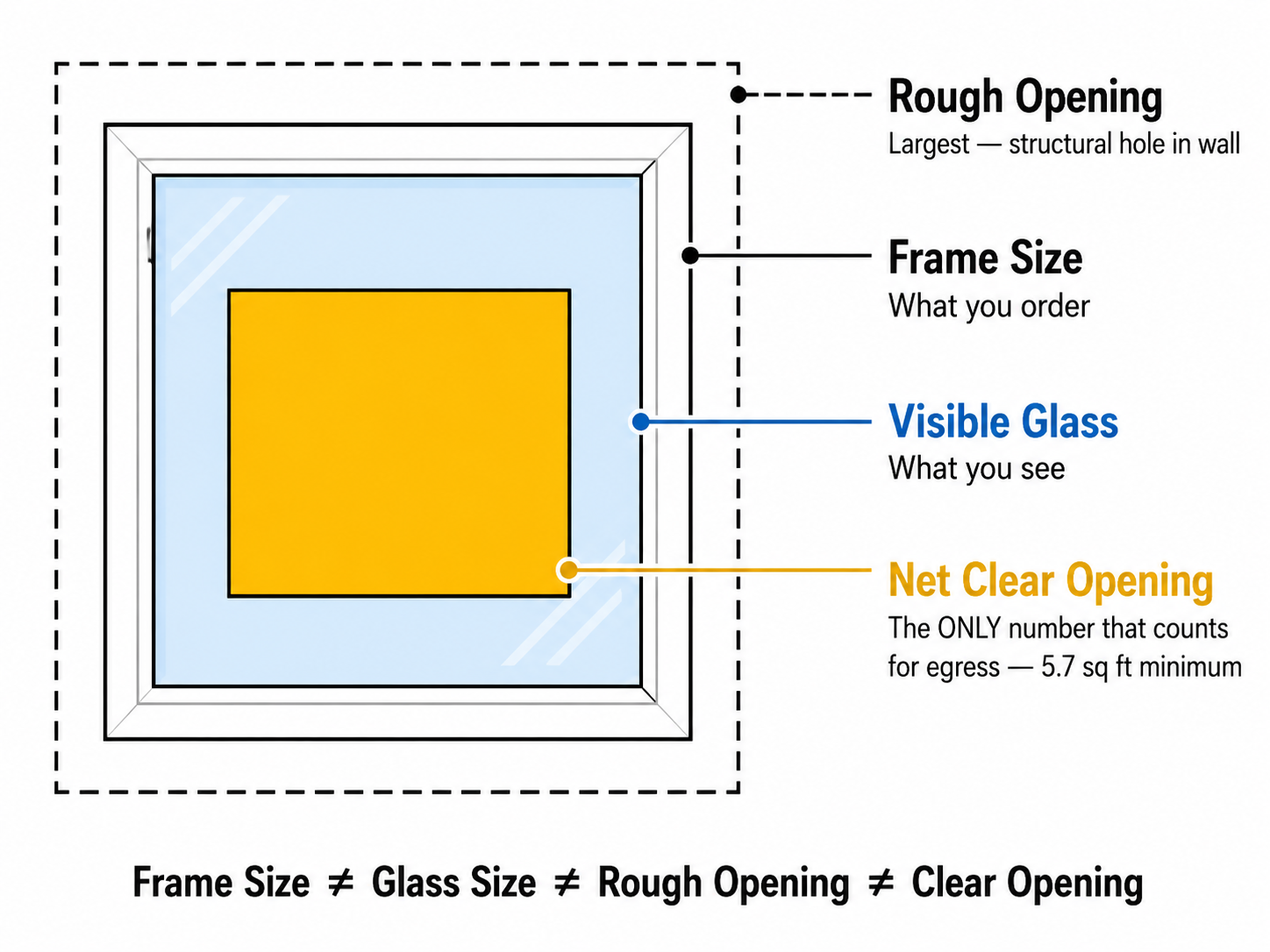
Now, here is the part that trips people up. That 5.7 square feet—the number everyone remembers—is not the glass size. It is not the rough opening the carpenter framed. It is the net clear opening. Imagine the window fully open. The net clear opening is the actual free space you could crawl through without squeezing past a sash or track. A window can have a huge pane of glass and still fail if it does not open wide enough.
A quick example from the code books makes this clear. Say you pick a window with a 20‑inch clear width and a 24‑inch clear height. Those dimensions meet the minimum width and height rules. But multiply them: 20 × 24 gives you only 480 square inches of opening. Divide by 144, and you get 3.3 square feet. That is nowhere near the 5.7 square feet the rule demands. To actually reach 5.7 square feet with a 20‑inch width, you would need the opening to be about 41 inches tall. Or, starting from a 24‑inch height, you would need a width of about 34 inches. Suddenly, the window gets a lot bigger than many people expect.
Because of these requirements, you cannot simply look at a label that says “36×30 window” and assume it works. You need to check the manufacturer’s listed clear opening dimensions for that exact model. That is true whether you are shopping off a shelf or having a custom solution built to fit your opening.
How Big Is a 5.7 Sq Ft Window in Inches? Breaking Down the Dimensions
You know the number: 5.7 square feet. But what does it actually look like on a tape measure? Let’s pull it apart step by step.
The 20×24 Trap: Why Minimums Alone Flunk the Code
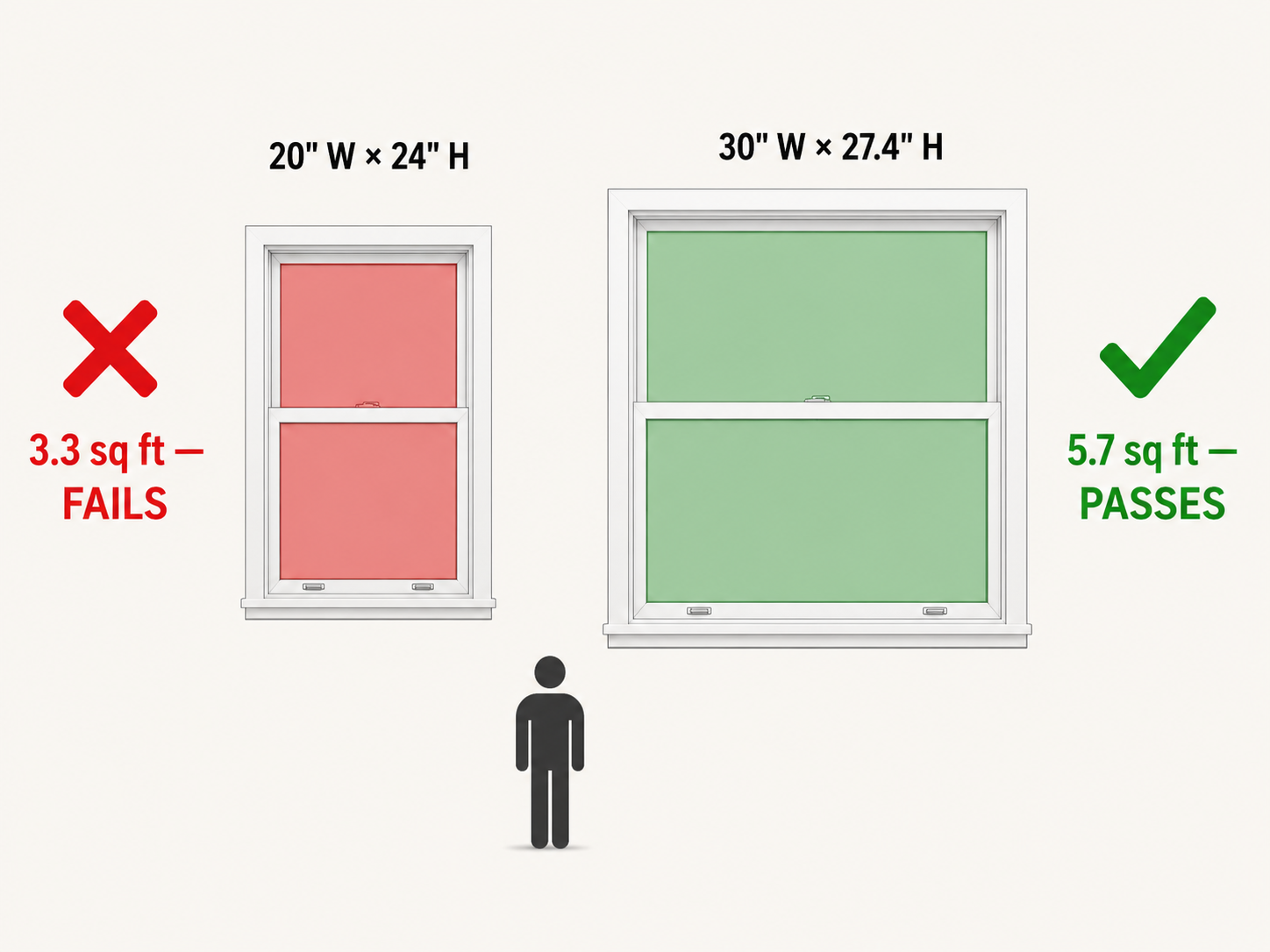
A window opening 20 inches wide and 24 inches high checks two boxes. It hits the minimum width. It hits the minimum height. So builders sometimes grab it, assuming they are safe. Then the inspector does the math.
20 × 24 = 480 square inches. Divide by 144. You get just 3.3 square feet. That is only a little more than half the required area. The code demands width and height and total area—all three at once. Miss one, and the window fails.
Doing the Math: 5.7 Sq Ft in Square Inches
First, convert the target into the unit you will actually measure with: inches.
The magic number
5.7 square feet × 144 square inches per square foot = 820.8 square inches
So you need an opening whose width times height equals at least 820.8. But you can’t just pick any pair of numbers. You must stay above 20 inches wide and 24 inches high. Let’s explore what happens when you lock one dimension at its minimum and solve for the other.
If the width is exactly 20 inches…
820.8 ÷ 20 = 41.04 inches. You would need a clear height of about 41.1 inches. That’s a tall, narrow slot—more than three and a half feet high but barely wider than a school ruler.
If the height is exactly 24 inches…
820.8 ÷ 24 = 34.2 inches. You would need a clear width of about 34.2 inches. That’s a short, wide rectangle—less than two feet tall but nearly three feet across.
Both shapes feel a little odd on a wall. They also put stress on hardware and can be awkward to operate or frame.
Clear Opening Combinations That Actually Reach 5.7 Sq Ft
In real life, manufacturers pick dimensions somewhere in the middle. The table below shows a few workable pairs. Notice how quickly a small boost in width shrinks the height you need.
Clear Width (in) | Clear Height Needed (in) | Total Clear Area (sq ft) |
|---|---|---|
20 | 41.1 | 5.7 |
22 | 37.3 | 5.7 |
24 | 34.2 | 5.7 |
26 | 31.6 | 5.7 |
28 | 29.3 | 5.7 |
30 | 27.4 | 5.7 |
Why Most Egress Openings Settle Around 30″ × 28″ (or Bigger)
Look at the bottom row. A clear opening 30 inches wide by 27.4 inches tall gives you 5.7 square feet. That shape feels comfortable. It is wide enough for shoulders. It is tall enough to climb through without ducking into a slit. And it gives manufacturers room to build a strong frame around the glass without making the whole unit enormous.
Here is what happens in practice:
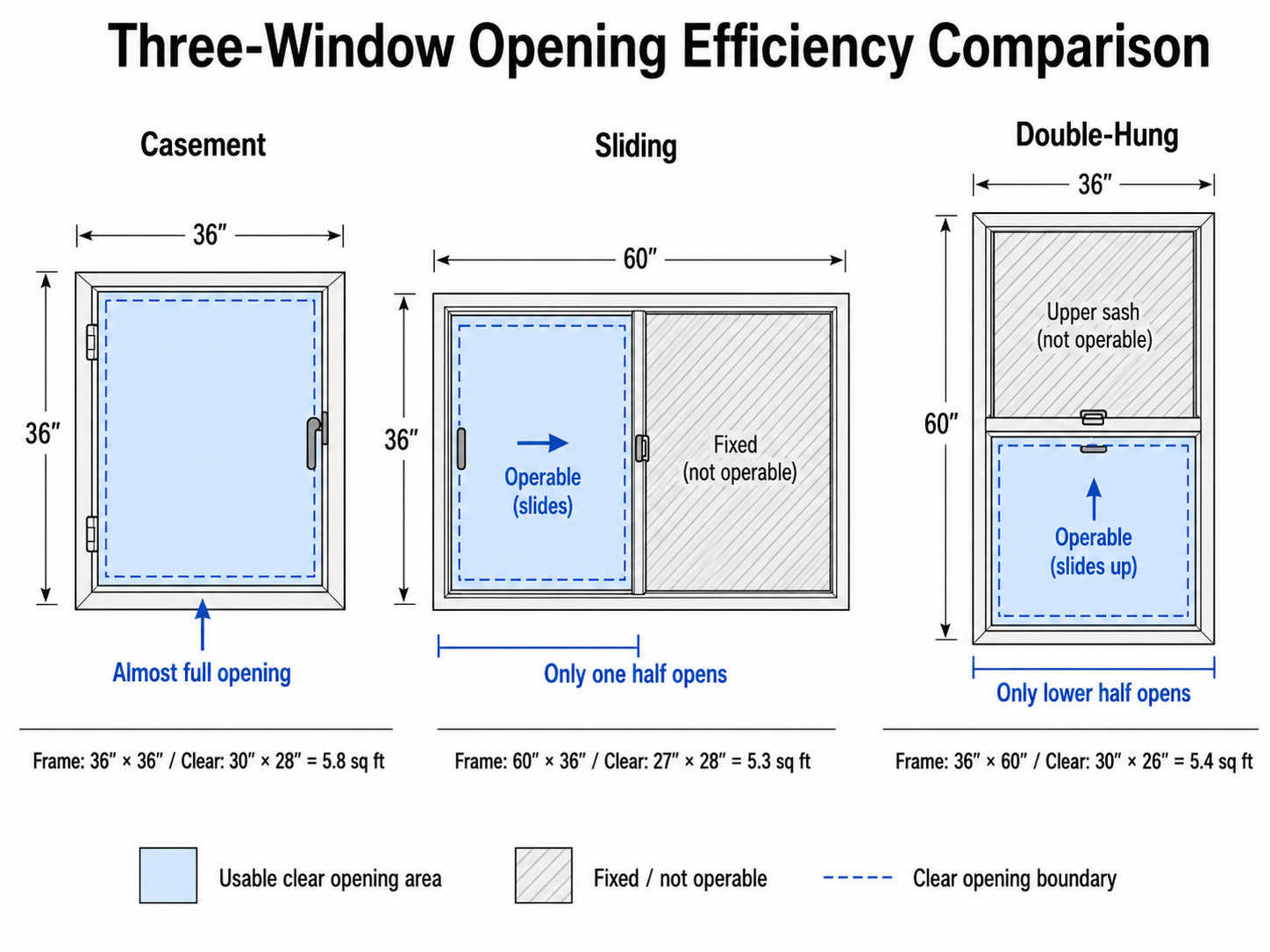
Casement windows that swing fully open can often hit a 30×28 clear opening with a frame size around 36 inches wide by 36 inches tall.
Sliding windows need a wider overall frame because only half the opening clears. A slider with a 30×28 clear might require a frame 60 inches wide or more.
Double‑hung windows nearly always need extra height. The sash that stays put cuts the clear opening roughly in half. So a double‑hung with a 30×28 clear opening might need a total frame height of 54 inches or taller.
That’s why you will hear contractors say, “Plan for a window frame at least three feet wide and three feet tall.” It’s not the law. But it’s a rule of thumb that keeps you out of trouble when you are sketching out a bedroom wall.
Net Clear Opening vs. Window Frame Size: Why You Can’t Just Look at the Glass
You measure the glass. It looks huge. So why would an inspector say it’s too small? The answer lies in a single phrase: net clear opening. It’s the actual space you can wiggle through when the window is open. It’s rarely the same as the frame size or the visible glass. And the way your window opens decides just how much of that frame turns into a real escape path.
Why the Operating Style Matters So Much
Picture two windows. Both have a frame 36 inches wide by 36 inches tall. One swings open like a door. The other slides sideways. They deliver wildly different clear openings. You can’t afford to guess. Here’s how each style behaves.
Single‑Hung and Double‑Hung Windows: The Half‑Height Problem
These classics open vertically. One sash slides up, but the other stays put. That fixed sash eats up half the frame height. A double‑hung window 36 inches tall often yields less than 17 inches of clear height. Even a 48‑inch‑tall unit can struggle to reach the 24‑inch minimum unless it’s unusually wide. If you want a hung window for egress, you almost always need a much taller frame to compensate.
Casement Windows: Nearly the Whole Frame Counts
Casements hinge at the side and swing outward. The entire sash moves clear of the opening. They often give you a clear width and height just an inch or two less than the frame itself. A casement with a 30‑inch‑wide frame might deliver a 28‑inch clear width. That efficiency makes them a top pick for hitting 5.7 square feet without an oversized unit.
Sliding Windows: Only a Portion Opens
Sliders move horizontally. One sash slides behind the other. Right away you lose overlap. A sliding window 60 inches wide might open only 28 inches. The height stays mostly intact, so you can make it work. But you need a wider rough opening and a larger total frame to get the same clear area a casement provides in a tighter footprint.
A Real‑World Spec That Almost Works
Let’s look at a real product example, similar to models listed for below‑grade use. It carries a frame size of 36 inches wide by 30 inches tall. Sounds generous. Yet its listed clear opening is just 30.25 inches wide by 25.25 inches tall. Multiply them: 30.25 × 25.25 equals about 764 square inches. Divide by 144, and you get 5.30 square feet. That clears the 5.0‑square‑foot mark allowed for some basements. But it falls short of 5.7 square feet. Install it in an above‑grade bedroom, and you’ve got a code violation. The frame fooled you.
The One Number You Must Hunt Down
The lesson is simple. The frame is a container. The glass is a pane. Neither one tells you if you can escape. You must find the net clear opening on the manufacturer’s spec sheet. It’s the only number the building inspector cares about.
You can save yourself a lot of trouble by comparing styles side by side. The table below shows how different windows turn a given frame into a clear opening. These are typical relationships, not guarantees—always verify with the manufacturer.
Window Style | Typical Clear Opening Ratio | Example Frame (W × H) | Approx. Clear Opening (W × H) |
|---|---|---|---|
Casement | 85–95% of frame area | 36″ × 36″ | ~30″ × 28″ |
Double‑Hung | 45–55% of frame area | 36″ × 48″ | ~30″ × 24″ |
Sliding (2‑panel) | 40–50% of frame area | 60″ × 36″ | ~28″ × 29″ |
Awning | 60–75% of frame area | 48″ × 24″ | ~34″ × 16″* |
*Awning windows often run into height limits long before they reach 5.7 sq ft. Always check the model.
When you order a custom window from DERCHI, don’t rely on the frame size in the quote. Ask for the product drawing. It should spell out three things: clear opening width, clear opening height, and clear opening area. Tell them your local code requirement up front. Then you can match the window to the rule before a single piece of aluminum gets cut.
How Big Is a 5.7 Sq Ft Window in Standard Window Sizes? Real-World Examples
You’ve seen the math. Now let’s translate it into actual products you might order. Standard window sizes follow a four‑digit code. A label reading “2840” means the unit is 2 feet 8 inches wide and 4 feet 0 inches tall. But those numbers usually describe the frame or the rough opening—not the clear opening. That is where things get tricky.
How Window Style Shapes the Clear Opening
Different window types waste different amounts of space to frames, tracks, and sashes. Here’s what you can typically expect when you shop for a window that delivers at least 5.7 square feet of clear opening:
Casement windows swing away fully. A casement with a frame size of 36 inches wide by 36 inches tall can often give you a clear opening around 30 inches by 28 inches—right at 5.7 sq ft.
Sliding windows lose nearly half their width. You might need a frame 60 inches wide to get a 28‑inch clear width. The height stays mostly intact, so a 36‑inch‑tall slider could deliver a clear height of 32 inches. Multiply 28 × 32, and you get 6.2 square feet. It works, but the unit is enormous.
Double‑hung windows suffer vertical losses. A 40‑inch‑wide by 56‑inch‑tall double‑hung might finally squeak past 5.7 square feet, because only half the height opens. This is why many builders skip hung windows for egress or go very tall.
Awning windows push outward from the top. They often look wide, but the open angle limits how much height you actually get. Many fail the 24‑inch minimum height before they even get to the area calculation.
Sample Frame Sizes That Can Hit the Mark
Here are a few common frame sizes paired with their likely clear openings. Use them as starting points, not promises. Always check the spec sheet for the exact model you’re buying.
Window Style | Common Frame Size (W × H) | Approximate Clear Opening (W × H) | Approx. Clear Area |
|---|---|---|---|
Casement | 36″ × 36″ | 30″ × 28″ | 5.8 sq ft |
Casement | 40″ × 32″ | 34″ × 24.5″ | 5.8 sq ft |
Sliding | 60″ × 36″ | 28″ × 29.5″ | 5.7 sq ft |
Sliding | 72″ × 36″ | 34″ × 29.5″ | 7.0 sq ft |
Double‑Hung | 36″ × 60″ | 30″ × 27″ | 5.6 sq ft |
Double‑Hung | 40″ × 64″ | 34″ × 29″ | 6.8 sq ft |
You can see why casements are the darling of egress planning. They give you the most clear opening for the smallest wall hole. Sliders and hung windows work, but they demand more real estate. DERCHI’s aluminum casement and sliding window lines follow these same principles. Their custom sizing means you can fine‑tune the frame to match both your wall and the clear opening you need.
Above-Grade vs. Below-Grade: The 5.0 Sq Ft Exception
Not every egress window must hit 5.7 square feet. The IRC allows a smaller minimum—5.0 square feet—for windows installed at grade level or below grade. This exception exists because basement escape paths already require a window well and a ladder. The combination of a slightly smaller opening plus the well still gives a viable exit.
Where the 5.0 Sq Ft Rule Applies
You can use the 5.0‑square‑foot exception when the window serves a basement bedroom or any habitable space below ground. It also applies to ground‑floor windows that sit essentially at grade. But here is the catch: some local building departments ignore the exception entirely. They enforce 5.7 square feet across the board. You must call your local inspector and ask.
How Much Difference Does It Make?
Let’s look at two products from the market that operate right on the boundary. A window with a frame of 36 inches by 30 inches opens to a clear area of 30.25 inches by 25.25 inches—that is 5.30 square feet. Another flips the orientation to 30 inches by 36 inches and opens to 24.25 inches by 31.25 inches—5.26 square feet. Both pass the 5.0‑square‑foot bar easily. Both fail the 5.7‑square‑foot requirement. If your project is above grade, neither one helps you.
What This Means When You Order
When you reach out to DERCHI for a basement egress window, tell them whether your local code follows the IRC’s 5.0‑square‑foot allowance. They can tailor the frame size. A custom aluminum window can be built narrower or slightly shorter, saving you money on structural work and window well excavation. Just don’t guess. A quick call to your building department can prevent an expensive reorder.
More Than Just Size: Full Egress Window Code Requirements
Area is only one piece of the puzzle. The IRC piles on several other rules. A window that clears 5.7 square feet can still fail inspection if it ignores these details.
Sill Height: 44 Inches Above the Floor
The bottom of the clear opening can sit no higher than 44 inches from the finished floor. Go higher, and a shorter person cannot reach it to climb out. In children’s rooms, the code also recommends a lower sill for furniture placement safety, but the 44‑inch maximum is what governs egress. During installation, you must account for carpet, tile, or hardwood thickness. A rough‑in measurement off the subfloor can mislead you by an inch or more.
Operation Without Keys or Tools
The window must open from the inside without a key, a tool, or special knowledge. A simple latch or lever is fine. A removable handle stored in a drawer is not. If you install security bars or grilles over the window, they must also open without a key and without reducing the clear opening below the minimum. DERCHI’s hardware options include multi‑point locks that disengage with a single handle throw, satisfying this rule neatly.
Below‑Grade Extras: Window Wells and Ladders
If your egress window sits below ground, the outside escape path matters just as much as the opening. The code demands a window well with a minimum floor area of 9 square feet and a horizontal projection of at least 36 inches. If the well is deeper than 44 inches, it needs a permanently attached ladder or steps. The window must also open fully into the well without hitting the wall. Before you order a custom window from DERCHI, measure your well. A beautiful casement that swings into the well and jams halfway open is useless in a fire.
How to Measure Your Window for a 5.7 Sq Ft Clear Opening
You have an existing window and you wonder if it’s large enough. Or you’re cutting a new opening and need to specify the rough opening correctly. Good measurements prevent expensive mistakes.
Step 1: Open It Fully
Crank the window as far as it will go. If it is a slider, push the sash to the end of its track. If it is a double‑hung, lift the sash until it stops. You want the maximum opening the hardware allows.
Step 2: Measure the Clear Width
Stretch a tape measure horizontally across the narrowest part of the opening. Measure from the inside edge of the frame on one side to the inside edge on the other. For sliders, ignore the stationary panel. For casements, measure the gap between the sash and the frame. Record the smallest number you find.
Step 3: Measure the Clear Height
Run the tape vertically from the sill to the top of the opening. Again, take the smallest measurement. On hung windows, measure from the sill to the bottom edge of the raised sash—not to the frame top.
Step 4: Calculate the Area
Multiply clear width by clear height. Divide by 144. If the result is 5.7 or higher, and both width and height meet their individual minimums, you have a compliant opening. If not, you need a larger window or a different style.
Step 5: Check the Sill Height
Measure from the finished floor to the bottom of the clear opening. It must sit at or below 44 inches. If you are still in the framing phase, estimate your finished floor thickness and subtract it from your rough sill height.
Step 6: Assess the Escape Path Outside
For ground‑floor bedrooms, ensure bushes or decks don’t block the exit. For basements, measure your window well depth and width. Confirm the well floor area hits 9 square feet and the projection extends at least 36 inches. If you need a custom window from DERCHI, send them these photos and measurements. Their technical team can then propose a frame and opening style that fits your wall and your well together.
DERCHI Custom Window Features for Egress Applications
When you turn to a custom manufacturer like DERCHI, you aren’t limited to the standard sizes on a shelf. You can specify your rough opening, your preferred operation style, your energy performance needs, and your finish—and they will build around the clear opening requirements.
DERCHI Casement Windows for 5.7 Sq Ft Egress
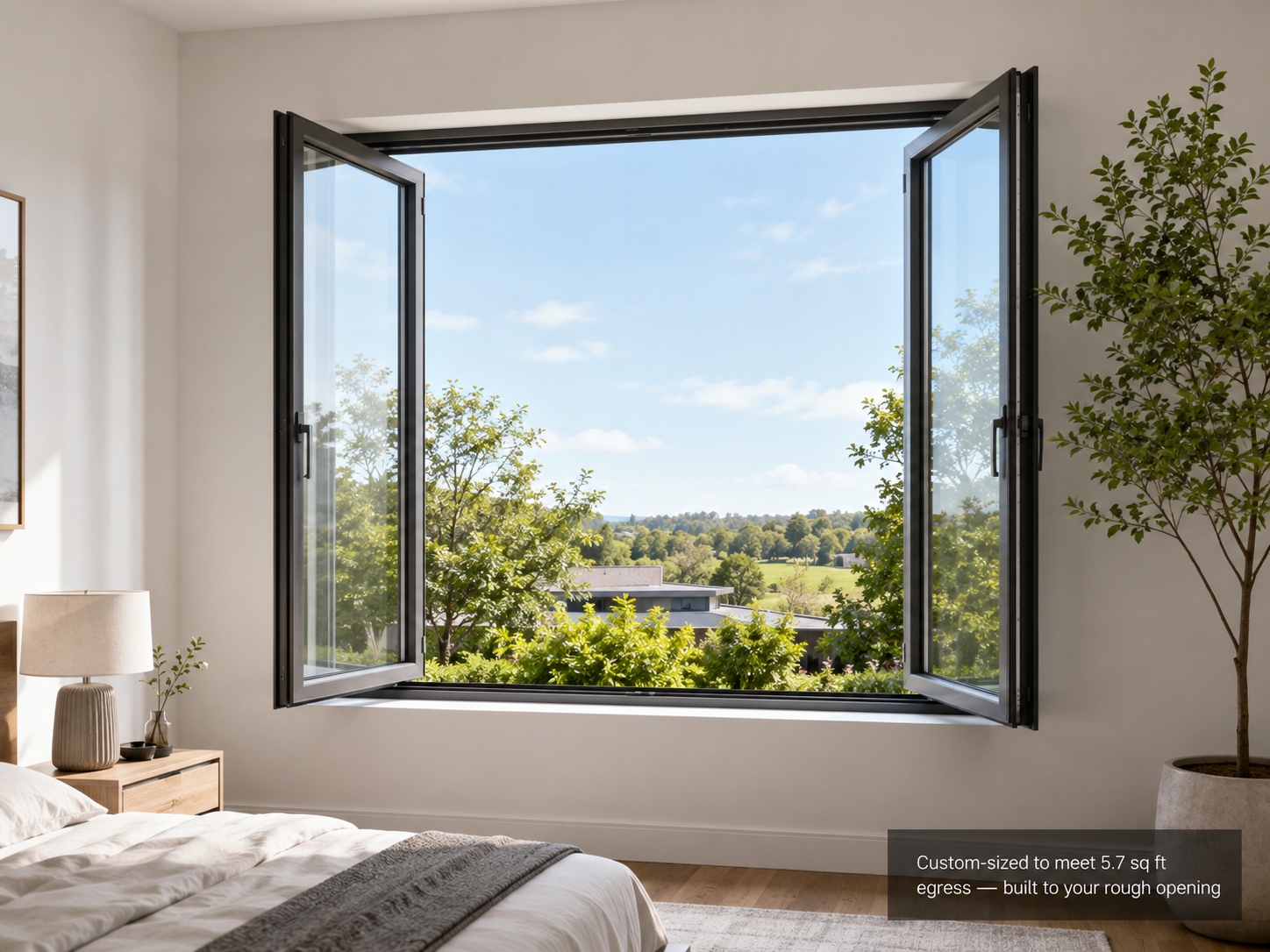
Casements remain the most efficient path to 5.7 square feet. DERCHI’s aluminum casement windows are built to swing fully open, maximizing the clear width and height. Their narrow frame profiles mean less metal gets in the way. You can order them with a left or right hinge, in custom widths from roughly 20 inches to 48 inches, and heights from 24 inches to 84 inches. For egress, a popular configuration is a frame around 36 inches by 36 inches, which delivers a clear opening near 30 inches by 28 inches.
DERCHI Sliding Windows for Bedroom or Basement Egress
Sliding windows from DERCHI use thermal break aluminum frames and multi‑track systems. They come in two‑, three‑, or four‑panel configurations. Because only one panel moves, you must specify a wider unit. A two‑panel slider 72 inches wide and 36 inches tall can offer a clear opening in the range of 34 inches by 30 inches—well above 5.7 square feet. Their sliding windows also include integrated drainage channels, making them suitable for basement openings where moisture control is critical.
DERCHI Awning Windows
DERCHI’s awning windows hinge at the top and push outward. They excel at ventilation in rain, but they rarely serve as primary egress. The opening angle restricts the usable height. If your jurisdiction allows a small secondary egress opening or you need a window for a bathroom that doubles as a light source, awning windows work beautifully. Just don’t count on them to satisfy the 5.7‑square‑foot rule without careful model verification.
DERCHI Picture/Fixed Windows
These are non‑operable. They let in light and frame a view. They cannot serve as an emergency escape. Combine a large picture window with a casement or slider on one side, and the room gains both daylight and code compliance. DERCHI fabricates fixed aluminum and UPVC windows in virtually any size, with low‑E glass options for energy efficiency.
Thermal Break Aluminum Frames
Aluminum conducts heat. A thermal break—a reinforced polyamide strip between the inner and outer frame profiles—stops that heat flow. DERCHI’s thermal break systems improve insulation by up to 40% compared to non‑thermal aluminum. For a bedroom or basement where comfort matters, this upgrade pays for itself quickly. It also reduces condensation risk on the frame interior.
DERCHI UPVC Series
Beyond aluminum, DERCHI offers UPVC casement and sliding windows. UPVC provides excellent insulation and sound dampening. It is also low‑maintenance, never needing paint. For egress, UPVC casements can be customized to the same clear opening dimensions as their aluminum siblings. Confirm the specific model’s clear opening specs with DERCHI before production.
Custom Project Support
DERCHI positions itself as a factory‑direct custom manufacturer. The process starts with you submitting your project details: rough opening size, room type, floor level, required clear opening, glass preferences, and local code requirements. DERCHI’s team translates those into technical drawings. Once you approve, they manufacture, quality‑check, pack, and ship. They also supply installation guidance. Because everything is made to order, your wait time might run a few weeks longer than buying off the shelf, but the window arrives sized precisely for your wall.
Standard vs. Custom Window Sizes for Egress: Which Approach Works?
Not every project needs a custom window. Sometimes an off‑the‑shelf unit fits perfectly. Other times, forcing a standard size costs more in structural work than a custom window ever would.
When a Standard Window Makes Sense
You are building new construction and can frame the opening to match a common egress‑rated casement or slider size.
Your existing rough opening happens to align with a standard frame that delivers 5.7 square feet.
You have a tight budget and need the lowest upfront product cost. Standard sizes often cost less per unit, though structural modifications may erase the savings.
When a Custom Window Is the Smarter Move
You are converting a basement. Existing openings are often smaller and irregular.
Your local code demands 5.7 square feet, and no standard size fits your wall without moving studs or replacing headers.
You want a specific operation style, color, or glass package that isn’t available in stock units.
Modifying the wall is expensive. Widening a rough opening requires a larger header beam and possibly an engineer. Lowering a sill is cheaper but still involves cutting sheathing and reframing. A custom window built to your existing width might be the most affordable path.
How DERCHI’s Custom Approach Helps
DERCHI does not simply resize standard designs. They engineer each window to your rough opening and performance requirements. If your rough opening is 34 inches wide and 38 inches tall, they can build a casement that yields a 28‑inch by 26‑inch clear opening—5.1 square feet, great for a basement—or adjust the sash geometry to reach 5.7 square feet if code demands it. The price difference between a slightly custom size and a “standard” size from a factory like DERCHI is often minimal, because their entire production line is set up for made‑to‑order work.
Common Mistakes When Buying a 5.7 Sq Ft Window
Even experienced renovators stumble on egress rules. Here are the pitfalls we see again and again.
Mistake 1: Shopping by Frame Size Alone
You see a 36×36 window and assume it clears 5.7 square feet. The salesperson nods. You install it. The inspector pulls a tape and says it only opens to 30×25 inches. Now you have a very expensive hole in your wall that fails code. Frame size means nothing. Only the clear opening counts.
Mistake 2: Using a Fixed Window as the Escape Route
Picture windows are not egress. Neither are transoms, glass block panels, or skylights. Your bedroom needs at least one window that opens far enough. If you love the look of a big fixed pane, flank it with two casements. One of them becomes your escape window.
Mistake 3: Installing the Window Too High
You build a beautiful window that opens to 30×30. But the sill sits 48 inches off the floor. The inspector flags it immediately. The 44‑inch maximum applies to the bottom of the clear opening, not the frame bottom. In a basement with a deep window well, you might actually have the opposite problem: the sill is too low to allow a comfortable step.
Mistake 4: Forgetting the Window Well in Basements
You size the window correctly, but the well is too small. It measures 32 inches by 36 inches—barely 8 square feet. The rule demands 9 square feet. Now you need a new well, which means digging. Measure the well before you order the window. If you are building both at once, design them together. DERCHI can suggest opening configurations that work with standard well sizes.
Mistake 5: Ignoring Local Code Variations
Some states adopt the IRC with amendments. A county might enforce a 5.7 square foot rule even for basements, removing the 5.0‑square‑foot exception. Others add requirements for tempered glass near walkways. Ask your local building department what edition of the code they follow and what egress window rules apply. Then pass that information to your window manufacturer.
Mistake 6: Not Getting Clear Opening Specs in Writing
Verbal promises don’t hold up at inspection. Before you approve the order, ask DERCHI or any manufacturer for the shop drawing showing the net clear opening width and height. Compare those dimensions to your code requirements. Sign off only when they match.
DERCHI 5.7 Sq Ft Window Pre-Order Checklist
Print this. Tape it to your project folder. Every box must be checked before you finalize your window order.
Area: Clear opening is at least 5.7 square feet (or 5.0 sq ft if below‑grade and locally approved).
Width: Clear opening width is at least 20 inches.
Height: Clear opening height is at least 24 inches.
Sill height: Finished floor to bottom of clear opening is 44 inches or less.
Operable: Window opens fully. It is not a fixed pane.
DERCHI drawing: You have a technical drawing that confirms the net clear opening dimensions.
Hardware: The latch or lock operates from inside without keys or tools.
Screen/grille: Any screen or security grille can be opened or removed without tools and does not reduce the escape path.
Below‑grade additions: If the window is below grade, you have a code‑compliant window well (minimum 9 sq ft area, 36‑inch projection) and ladder if required.
Local code: You have written confirmation from your building department about the required clear opening area and any local amendments.
Quote details: Your DERCHI quote includes frame material, glass type, color, hardware, packing, and shipping terms.
Questions to Ask Your Window Manufacturer Before Ordering
When you sit down to spec a custom egress window, arm yourself with these questions. They apply whether you are dealing with DERCHI or any other supplier.
Can this model deliver a net clear opening of at least 5.7 square feet?
What are the exact clear opening width and height on this unit?
Does the window open from the inside without a key or a tool?
What rough opening size do I need to frame for this clear opening?
Is this window rated for egress in a bedroom or basement?
What are my options for thermal break frames and insulated glass?
Can I get a custom color, custom size, or special hardware finish?
Will you provide installation drawings and clear opening certifications?
What packing and shipping protections do you use? What if the unit arrives damaged?
What is the lead time from order approval to delivery?
Frequently Asked Questions About How Big a 5.7 Sq Ft Window Is
How big is a 5.7 sq ft window in simple terms?
It is an opening of 820.8 square inches. Think of a clear space roughly 30 inches wide by 28 inches tall, or 24 inches wide by 34 inches tall. The shape changes with the style, but the total area is fixed.
Is a 20×24 window big enough for egress?
No. A 20‑inch by 24‑inch opening gives only 3.3 square feet. It meets minimum width and height but fails the area requirement by a wide margin.
Does the 5.7 sq ft measurement include the frame?
Never. It is the free, open space you can actually pass through. The frame, the glass, and the rough opening are all larger than the clear opening.
Can a double‑hung window be an egress window?
Yes, but the overall frame usually needs to be much taller than you expect. A double‑hung unit might need a frame height of 60 inches or more to deliver 24 inches of clear height and enough width to reach 5.7 square feet.
Are egress windows required in all bedrooms?
Every sleeping room needs at least one emergency escape window unless it has a door leading directly outside. That includes basement bedrooms and attic conversions.
What if my window measures 5.3 square feet? Will it pass?
Only if it is in a grade‑floor or below‑grade location where your local code allows a 5.0‑square‑foot exception. For above‑grade bedrooms, 5.3 sq ft is not enough.
Which window type is easiest to get 5.7 sq ft with?
Casement windows. They waste very little opening area to hardware or overlapping sashes. A casement with a relatively compact frame can usually hit the mark.
Can DERCHI build a custom egress window for my basement?
Yes. DERCHI manufactures custom aluminum and UPVC windows to order. Provide your rough opening measurements, your local code requirements, and your desired operation style. They will propose a configuration that meets your egress needs.
What should I send DERCHI when I request an egress window quote?
Include your wall opening dimensions, wall thickness, room type, whether it is above or below grade, your target clear opening (usually 5.7 sq ft), preferred window style, any glass or color preferences, and the relevant local building code rules.
Conclusion
A 5.7 square foot window translates to 820.8 square inches of net clear opening. It can take the shape of a 20‑by‑41‑inch slot, a 24‑by‑34‑inch rectangle, or the common 30‑by‑28‑inch configuration that feels balanced on a wall. The frame always measures larger. The glass always looks bigger. Neither of those numbers matters at inspection time. What matters is the open space you can actually climb through.
Start with the style. Casement windows give you the most efficient path to compliance. Sliders and hung windows can work if you size them generously. Always pull the manufacturer’s spec sheet. If standard sizes don’t fit your rough opening, a custom window built to order saves you from tearing into headers and siding. DERCHI and similar custom manufacturers can engineer a solution around your wall, your local code, and your design preferences. Measure twice. Confirm your code. Get the clear opening in writing. Then place the order. The safety of your family and the legality of your bedroom count on it.