


Before you order a sliding window replacement, decide whether the project is sash-only, insert, or full-frame. Then measure for that scope, verify label requirements for the climate and orientation, and have the final size and installation details checked against the manufacturer’s instructions.
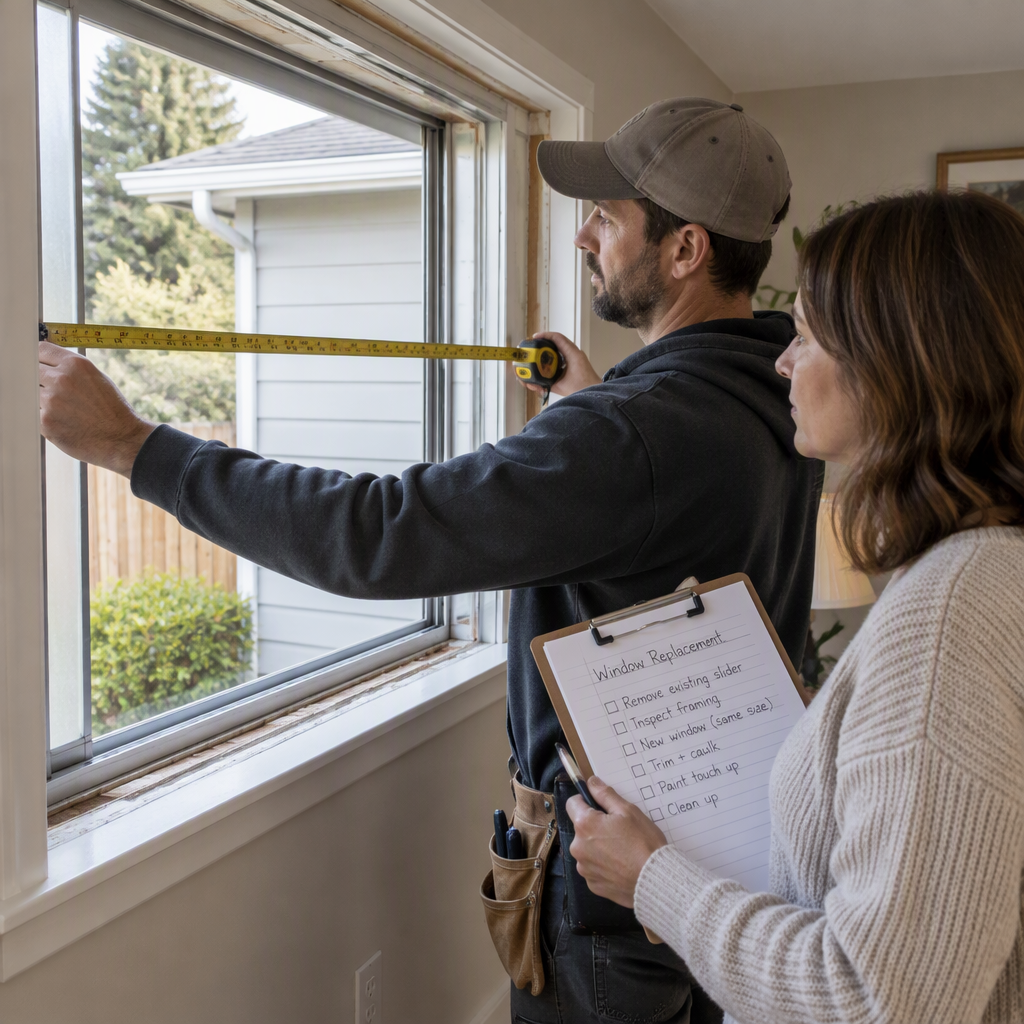
Choose the replacement scope first: sash, insert, or full frame
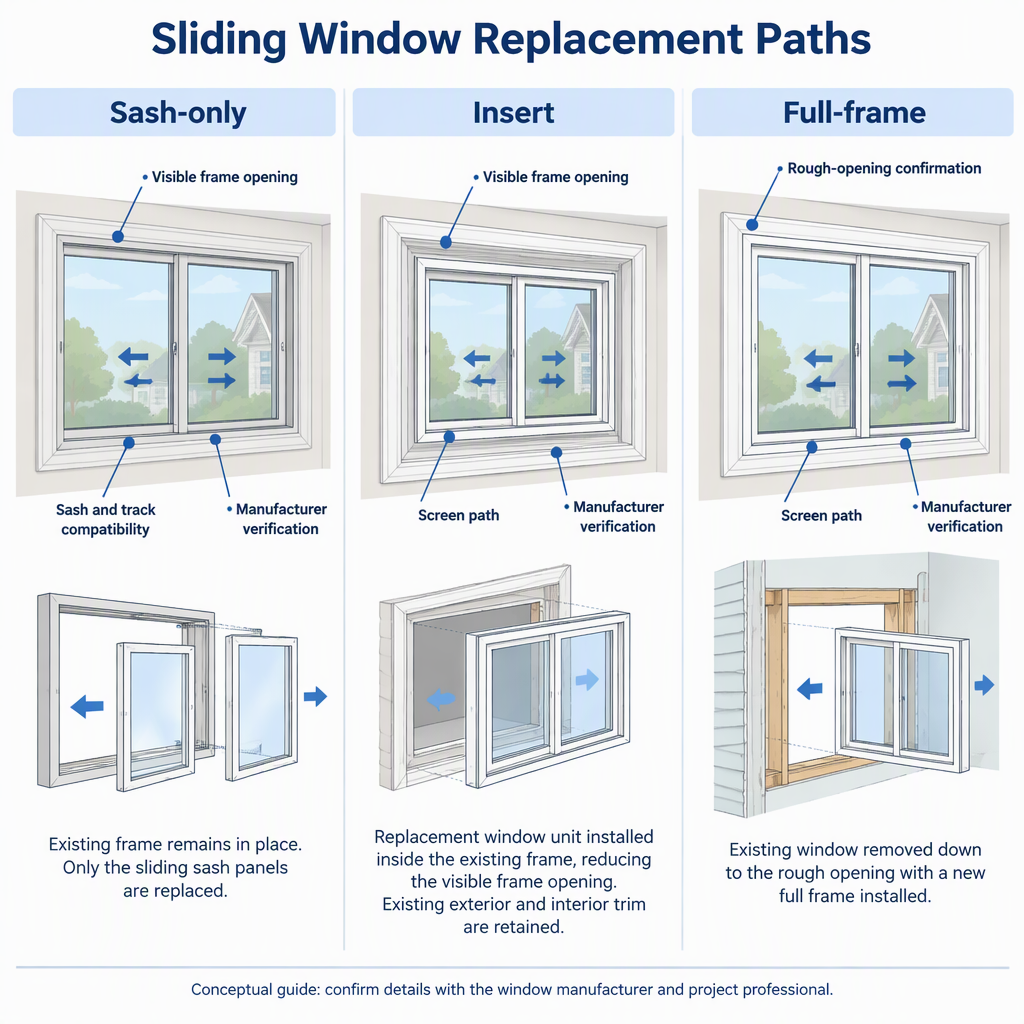
Choose the replacement scope before measuring: sash-only work depends on exact compatibility, insert replacement keeps more of the existing frame, and full-frame replacement exposes the wall opening and installation details that must follow the manufacturer’s instructions.
Many ordering mistakes happen when a homeowner measures the visible glass or sash before deciding what will actually be replaced. A sliding window may look simple from inside the room, but the order size can change depending on whether the old frame remains, is partly covered, or is removed.
| Replacement scope | What usually stays | Best used when | What to verify before ordering |
|---|---|---|---|
| Sash-only | The existing outer frame and tracks | The frame is sound and the sash system is compatible | Track profile, rollers, locks, weatherstripping, screen path, and supplier compatibility |
| Insert or pocket | Most of the existing frame | The frame is square, stable, and acceptable to keep | Visible opening, frame depth, sill condition, trim clearance, and loss of glass area |
| Full frame | Little or none of the existing window frame | The frame is damaged, the opening must be corrected, or the project needs a different frame system | Rough opening, wall condition, flashing approach, exterior finish, interior trim, and installation instructions |
What to measure before ordering a sliding replacement window
Measure the opening only after the replacement scope is defined, then record the dimensions, frame condition, sill and track details, screen requirements, and wall or trim constraints for the supplier or installer to verify.
If you are considering DERCHI’s E2T aluminum sliding window, the product page describes customization choices such as color finishes, track layout, glass options, and frame configurations, so the measurement package should describe more than width and height.
- Record the project scope: sash-only, insert, or full-frame.
- Measure width and height in several places, then mark which numbers are field measurements rather than final order sizes.
- Photograph the interior trim, exterior finish, sill, head, side jambs, and drainage area.
- Note the track layout, moving panel direction, fixed panel position, and whether a screen is required.
- Describe the preferred glass option, frame color, and configuration only as requested choices, not as verified performance results.
- Identify the room, exterior exposure, approximate orientation, and any shading or strong sun exposure that may affect product selection.
- Keep the final order open until the supplier or installer confirms the manufacturer’s sizing and installation requirements.
Check sash and frame compatibility before choosing sash-only replacement
A sash-only replacement is realistic only when the existing frame, track, rollers, locks, weatherstripping, and screen system can accept the replacement sash without creating operation or fit problems.
Sliding window systems are not universal. Even when two products are both horizontal sliding windows, the track shape, panel thickness, lock position, and screen path can differ by manufacturer and model.
- Check whether the replacement sash belongs to the same compatible product system.
- Confirm that rollers or guides match the existing track.
- Confirm that the lock meeting rail aligns with the frame hardware.
- Check whether the insect screen, if used, has the correct path and clearance.
- Inspect the old frame for distortion, corrosion, damage, or blocked drainage before keeping it.
Match glass, ratings, and orientation to the project
For energy and comfort, compare verified labels rather than generic claims: ENERGY STAR climate-zone fit, NFRC ratings, glass package, orientation, and manufacturer documentation should guide the sliding-window specification.
ENERGY STAR advises buyers to choose windows certified for their climate zone, look for ENERGY STAR and NFRC labels, keep documentation, account for orientation, and follow manufacturer installation instructions.
The National Fenestration Rating Council explains that residential certification provides independent third-party verification for ratings such as U-factor, solar heat gain coefficient, visible transmittance, air leakage, and condensation index.
| Item to compare | Why it matters | What to ask for |
|---|---|---|
| Climate-zone fit | A window suitable for one climate may not be the right choice for another. | ENERGY STAR guidance or documentation for the project location |
| U-factor | NFRC identifies U-factor as an energy-performance rating used for fenestration products. | A verified label or certification record for the exact configuration |
| Solar heat gain coefficient | NFRC identifies SHGC as one of the ratings used to compare solar heat gain. | A rating matched to orientation, shading, and comfort goals |
| Air leakage | NFRC includes air leakage among residential fenestration rating terms. | A verified rating, not a general statement |
| Glass and frame options | DERCHI’s E2T product page lists glass options, color finishes, track layout, and frame configurations as customization dimensions. | A written configuration that matches the project and product system |
For public energy-label guidance, see the ENERGY STAR residential windows, doors, and skylights page. Use it to understand label selection, not as proof that any specific product configuration is certified.
Plan installation scope around water management
Full-frame replacement needs more installation review because the window opening, surrounding wall, air sealing, and manufacturer instructions all affect the finished result.
ENERGY STAR guidance for replacement projects includes following manufacturer installation instructions and considering air sealing. Those steps matter more when the old frame is removed and the opening is exposed.
- Confirm whether the old frame will stay, be covered, or be removed.
- Have the installer inspect the opening condition before final order sizing.
- Review how the window will be installed according to the manufacturer’s instructions.
- Plan interior and exterior finish work before approving the order.
- Keep product labels and documentation with the project records.
Use manufacturer instructions and official project documentation as the controlling installation references. General energy guidance can help frame the questions, but it does not replace job-specific installation requirements.
Prepare a quote request without over-specifying the wrong window
A useful quote request identifies the chosen replacement scope, opening measurements, frame condition, glass and screen needs, orientation, exposure, and any code or project-document requirements without assuming unverified ratings or costs.
For a DERCHI sliding-window discussion, you can use the E2T Series aluminum sliding window page as product context and the sliding window category page to compare related sliding-window options.
- State whether the request is for sash-only, insert, or full-frame replacement.
- Attach photos and field measurements, clearly labeled as not final order sizes until verified.
- List the desired track layout, panel direction, screen requirement, frame color, and glass preference.
- Describe the climate, orientation, sun exposure, and room use.
- Ask for verified NFRC or other applicable rating documentation when energy performance is part of the selection.
- Ask the installer or supplier to identify any local code, egress, project drawing, or approval requirements before ordering.
- Do not include assumed prices, lead times, impact approvals, or certification claims unless they are supported by current project documents.
Conclusion
Sliding window replacement is easiest to plan when scope, measurements, labels, and installation risks are separated before the order is placed.
- Choose sash-only, insert, or full-frame scope before measuring.
- Check sash, track, lock, screen, glass, and frame-configuration compatibility before assuming a replacement part will fit.
- Use climate-zone guidance, orientation, and manufacturer instructions when planning energy-related choices.
- Ask for verified performance labels when ratings are important to the project.
A good sliding window replacement order starts with a clear scope and a verified measurement package. If the existing frame is sound and compatible, a limited replacement may be practical. If the frame, sill, or opening needs correction, a full-frame plan gives the installer more control but also requires more careful installation review.
FAQs about sliding window replacement
These answers address the common follow-up questions readers ask after choosing a sliding-window replacement scope.
Can I replace only the sash on a sliding window?
Sometimes, but only when the replacement sash is compatible with the existing frame, track, rollers, locks, weatherstripping, and screen system. If those parts do not match, a wider replacement scope should be reviewed.
Should I measure the glass or the frame opening?
Measure the project based on the replacement scope. Glass size alone is usually not enough for ordering because sash, insert, and full-frame work can require different reference points.
Is insert replacement the same as full-frame replacement?
No. Insert replacement keeps more of the existing frame, while full-frame replacement removes more of the old window system and requires closer review of the surrounding opening and installation instructions.
Which energy label should I check first?
Start with climate-zone suitability and ENERGY STAR guidance, then review NFRC rating information for the exact product configuration when energy performance is part of the decision.
What do NFRC ratings tell me?
NFRC residential certification covers independently verified rating information such as U-factor, solar heat gain coefficient, visible transmittance, air leakage, and condensation index.
Can a sliding replacement window be used for bedroom egress?
Possibly, but do not assume it. Egress depends on the adopted local code, the exact clear opening, the window configuration, and the authority having jurisdiction. Ask the architect, builder, installer, or local official to verify the requirement before ordering.
What DERCHI information is useful for a sliding-window quote?
DERCHI’s E2T product page is useful for discussing available customization dimensions such as color finishes, track layout, glass options, and frame configurations, but project-specific ratings or approvals should be verified with current documents.


