


80 Series Aluminum Folding Door
The 80 Series Aluminum Folding Door page lists optional integrated swing panels for daily access and identifies a CMECH aluminum alloy handle, hinges, and special lock points in its page specifications.


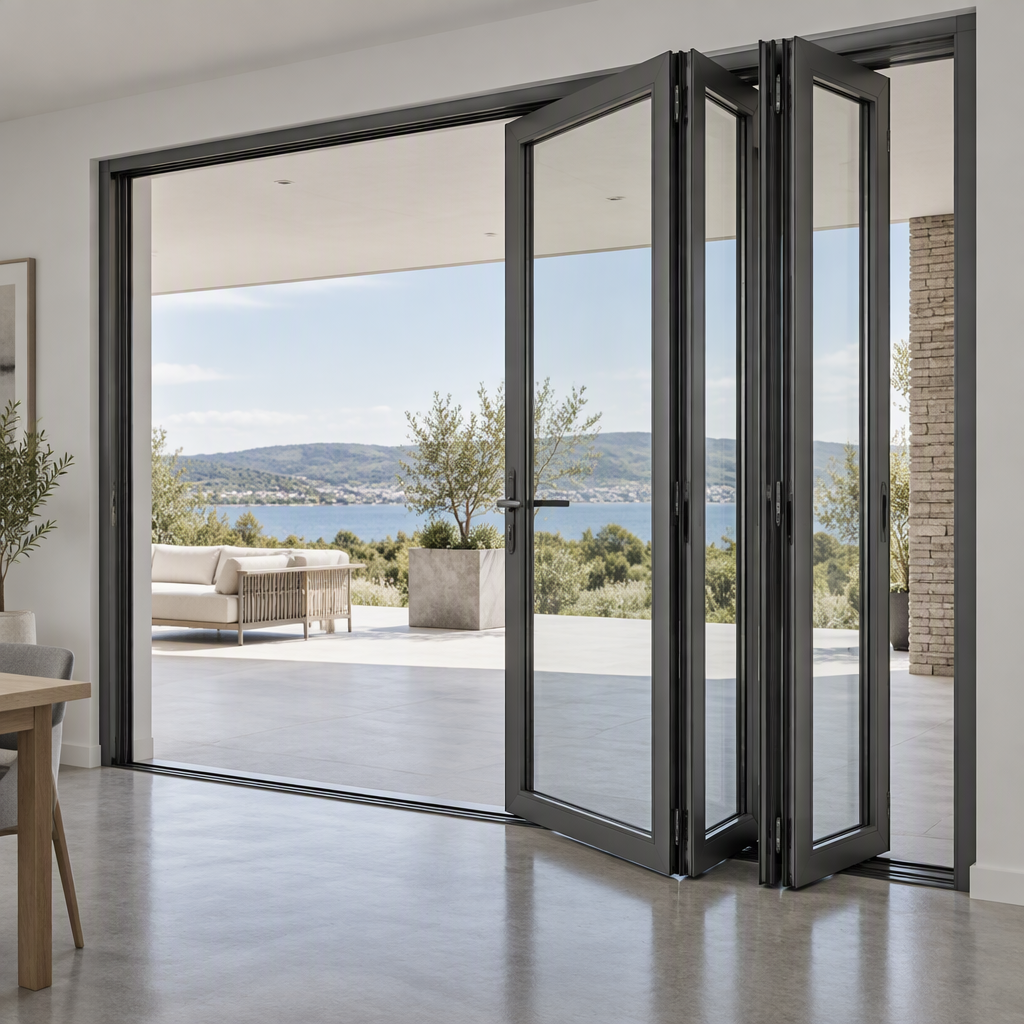
The main bifold door handle types are traffic-door handles, locking handles, folding pulls, flush or low-profile pulls, and manufacturer-matched hardware sets; the right choice depends on whether the panel works as a daily door, a folding leaf, or both.
A bifold door is not handled like a single swing door. Some panels fold and stack, one panel may act as a daily access door, and the lock, hinge, roller, and pull hardware must work as one package. DERCHI’s aluminum bifold pages describe hardware sets for folding systems, including handles, hinges, rollers, and locking points on specific product pages.
| Handle type | Best use | Clearance concern | Specification note |
|---|---|---|---|
| Traffic-door handle | Daily entry through one active panel | Must not hit the adjacent folding panel, wall, screen, or blind | Confirm swing direction, lock function, and manufacturer compatibility |
| Folding pull | Opening and closing panels as a folding set | Grip projection can reduce stack clearance if it is too proud of the panel | Use hardware matched to the panel and folding layout |
| Locking handle | Exterior or secured openings where locking is part of the system | Lock body, strike, and handle operation need room at the meeting stile | Review lock points with the door supplier |
| Flush or low-profile pull | Tight stack areas or interior-facing surfaces | Grip depth may be easier to clear but may feel different in use | Check comfort and accessibility before choosing it for daily use |
Choose a traffic door handle when one active panel will be used every day without opening the full bifold wall; choose simpler folding pulls when the panels are normally opened as a complete folding set.
DERCHI’s 80 Series Aluminum Folding Door page states that optional integrated swing panels are available for daily access, which is the situation where a traffic-door handle is most relevant.
| Project condition | Likely handle direction | Why it matters |
|---|---|---|
| People pass through the opening many times a day | Use a traffic-door handle on the active leaf | The door can work like a regular passage door without folding the whole system |
| The wall opens mainly for parties, patios, or occasional ventilation | Use folding pulls or the manufacturer’s standard folding hardware | The grip only needs to help move the panels when the full set is opened |
| The active leaf must lock from outside | Review the complete locking-handle set | The handle, lock, strike, and panel configuration must be compatible |
| The stack parks near a wall or fixed panel | Favor low-profile or carefully located pulls | Extra projection can create impact points when the panels fold |
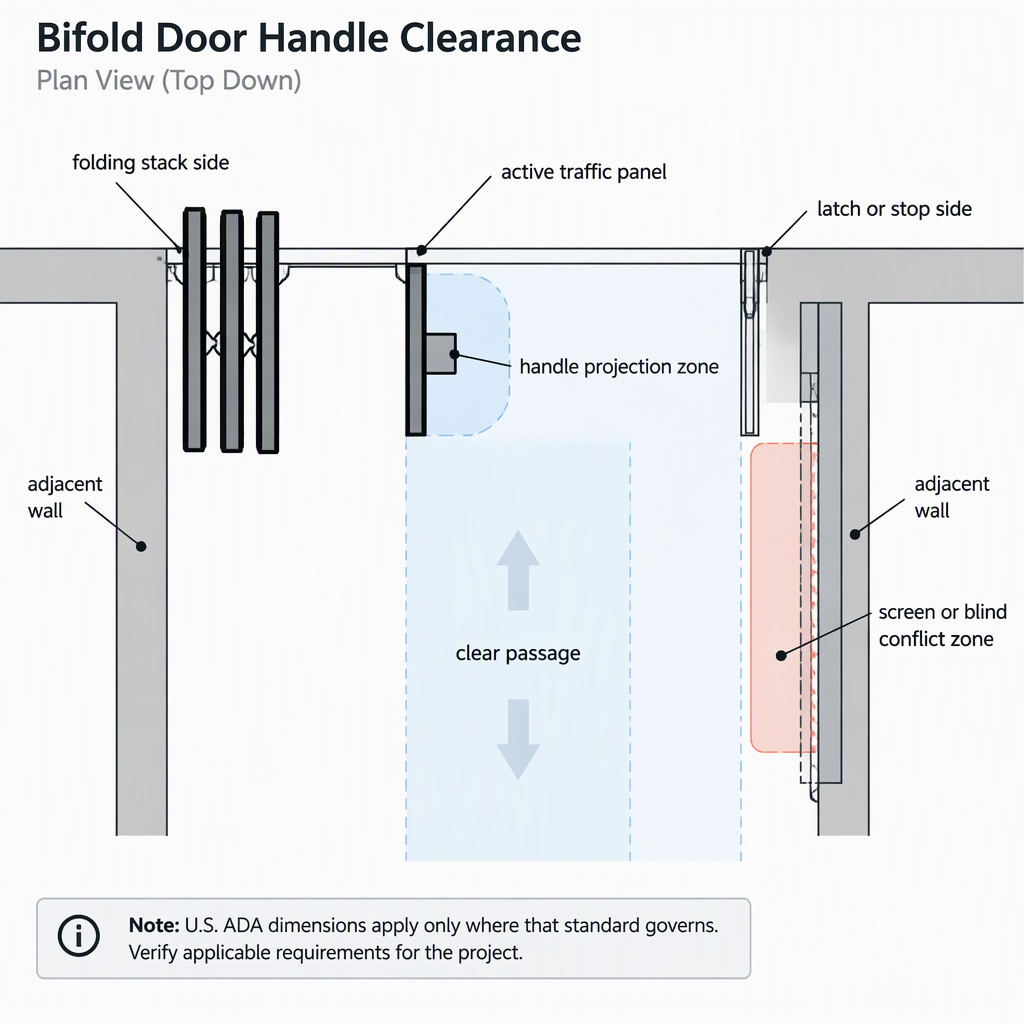
Bifold handle clearance is about more than the grip: check the panel swing path, folded stack thickness, handle projection, adjacent walls, screens, blinds, furniture, and the clear passage left when the door is open.
DERCHI’s 80 Series page describes compact panel stacking, and the WZ-78 page describes folding configurations from 2 to 9 panels. Those page-level facts support the main planning point: the handle must be checked against the actual panel layout, not chosen in isolation.
For U.S. accessible routes, ADA Chapter 4 includes requirements for folding doors, including clear opening width, maneuvering clearance, threshold limits, hardware height, usable operation, and opening force; local project review is still required.
The U.S. Access Board’s ADA Chapter 4 is the relevant public source for U.S. accessible-route door requirements, and its manual-door provisions include sliding and folding doors.
| Clearance item | Why it affects handle choice | What to verify |
|---|---|---|
| Clear opening | A bulky handle or folded stack can reduce usable passage | Final clear passage with the door in its intended open position |
| Maneuvering clearance | Users need room to approach, reach, pull, push, and pass through | Door swing, latch side, approach direction, and nearby obstructions |
| Threshold | The sill can affect accessible movement through exterior openings | Project threshold detail and local accessibility review |
| Opening force and operation | Hardware that is hard to grip or move can fail the usability goal | Complete door, handle, latch, lock, closer, and roller operation |
Accessible door hardware should be located and operable so users can reach and use it without tight grasping or complex hand movement where ADA applies; verify the final handle, lock, closer, and panel configuration together.
For U.S. accessible routes, handle selection is not just a style decision. The reachable location, the way the user grips the handle, and the force needed to operate the door all matter under ADA Chapter 4.
Use the official accessibility source and the project professional’s review together. A handle can meet the intended grip concept while the opening still fails because of width, threshold, maneuvering clearance, force, or installation details.
Exterior bifold door handles should be selected with the whole door package, because weather seals, locking points, screens, glass options, and panel direction can affect both comfort and hardware fit.
DERCHI’s bifold door category page discusses aluminum bifold door styles, glass options, inward and outward opening choices, hardware, and customization context. For handle planning, those are connected decisions.
DERCHI product pages can be useful examples for aluminum bifold door systems and hardware discussions, but use page-level facts only and do not treat marketing copy as independent proof of performance, certification, or code approval.
The 80 Series Aluminum Folding Door page lists optional integrated swing panels for daily access and identifies a CMECH aluminum alloy handle, hinges, and special lock points in its page specifications.
The WZ-78 Thermal Break Folding Door page describes 2- to 9-panel folding configurations and lists KERSSENBERG handle, concealed hinge, roller, and locking-point hardware on that page.
The DERCHI bifold door category page is a broader place to compare aluminum bifold door styles, opening direction, hardware context, glass options, and customization steps.
Before ordering, confirm the opening size, active traffic panel, folding direction, stack side, handle projection, lock function, accessibility needs, glass or blind package, screen choice, and who is responsible for field measurements and installation review.
A good bifold handle choice makes daily use simple without blocking the fold, reducing clear passage, or creating a conflict with the door’s hardware and accessibility requirements.
Start with the daily-use pattern. If one panel acts like a normal door, plan a traffic-door handle and lock set with the exact folding layout. If the opening is used mainly as a full folding wall, prioritize folding pulls that clear the stack. Then verify accessible clearances, local code needs, weather exposure, glazing, privacy, and installation scope before ordering.
These FAQs answer common handle, traffic-door, clearance, accessibility, compatibility, maintenance, and DERCHI-product questions without replacing project-specific review.
It is the handle used on an active panel that can operate like a daily passage door instead of opening the full folding set. DERCHI’s 80 Series page describes optional integrated swing panels for daily access.
No. Folding pulls may be enough when the door is normally opened as a full panel set, but a frequently used active leaf may need traffic-door hardware and a compatible lock arrangement.
Projection matters because the grip can collide with a folded panel stack, wall return, screen, blind, or furniture. Ask for the exact handle drawing when the stack area is tight.
No. Handle choice is only one part of accessibility. Clear opening width, maneuvering clearance, threshold detail, hardware height, operability, opening force, and local project review can all affect compliance.
Review the 80 Series Aluminum Folding Door page, the WZ-78 Thermal Break Folding Door page, and the DERCHI bifold door category page for page-level information about aluminum bifold systems and listed hardware.
They can be. Exterior systems usually need the handle, lock points, seals, glass, screen, finish, and panel direction reviewed together as part of the door package.
Plan routine visual checks for loose fasteners, smooth operation, and interference at the stack, and follow the supplier’s instructions for the specific handle, hinge, roller, and lock hardware.


