


A bifold door that whistles in the wind should be treated first as an air path problem: wind is getting through a small gap at the seals, track, trim, threshold, meeting stile, or rough opening, so diagnosis should start with drafts, visible gaps, and careful testing before parts are replaced.
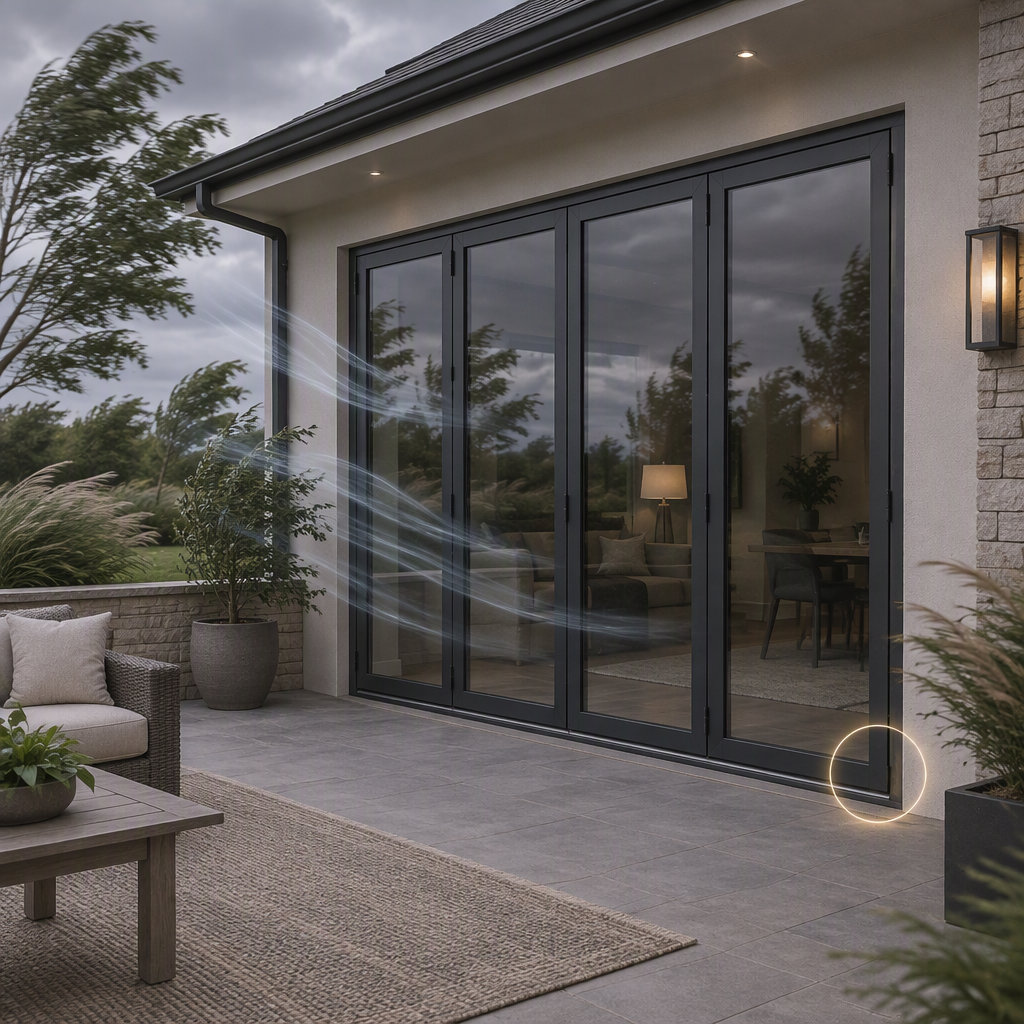
Why does a bifold door whistle in the wind?
A bifold door whistles when wind finds a narrow leak path through or around the closed assembly; ENERGY STAR’s guidance on sealing and insulating treats drafts around doors as air leakage that can often be improved with appropriate sealing methods.
On a folding door, that path can be hard to see because the door has more joints than a simple hinged door: panel-to-panel meeting points, top and bottom tracks, jamb seals, threshold areas, locks, and trim lines can all be involved.
How to find the air path before changing parts
Find the leak by closing and locking the door, checking for drafts and visible gaps, then using simple paper or smoke tests around the trim, jambs, seals, and threshold.
- Close the bifold door fully and engage the normal locking points so the seals are under their intended compression.
- Move slowly around the perimeter and look for visible light, open trim lines, loose caulk at fixed trim, or places where dust and odors enter.
- Use a paper test at suspected seal points: if the paper slides out with very little resistance, the seal may not be compressing evenly.
- Use a smoke test only in a safe, controlled way and keep flame, heat, and smoke away from finishes, curtains, and children.
- Mark the exact location of the draft before buying seals, adjusting hardware, or calling an installer.
- Check the head track, sill or threshold, side jambs, meeting stile, and trim-to-wall joint separately.
- Compare the windward side and leeward side; a gap may only whistle when pressure comes from one direction.
- Do not inject expanding foam beside the frame unless the door manufacturer or installer permits it; ENERGY STAR warns that sealing materials should not deflect frames.
Common bifold door whistle causes and what to check
The most common areas to check are seals, meeting stiles, tracks, thresholds, hardware compression, trim gaps, and the rough opening around the frame; DERCHI’s 93 Bifold Door page describes a folding aluminum door system with tracks, hinges, handles, locking points, glass options, frame casing choices, and EPDM rubber strip sealing material.
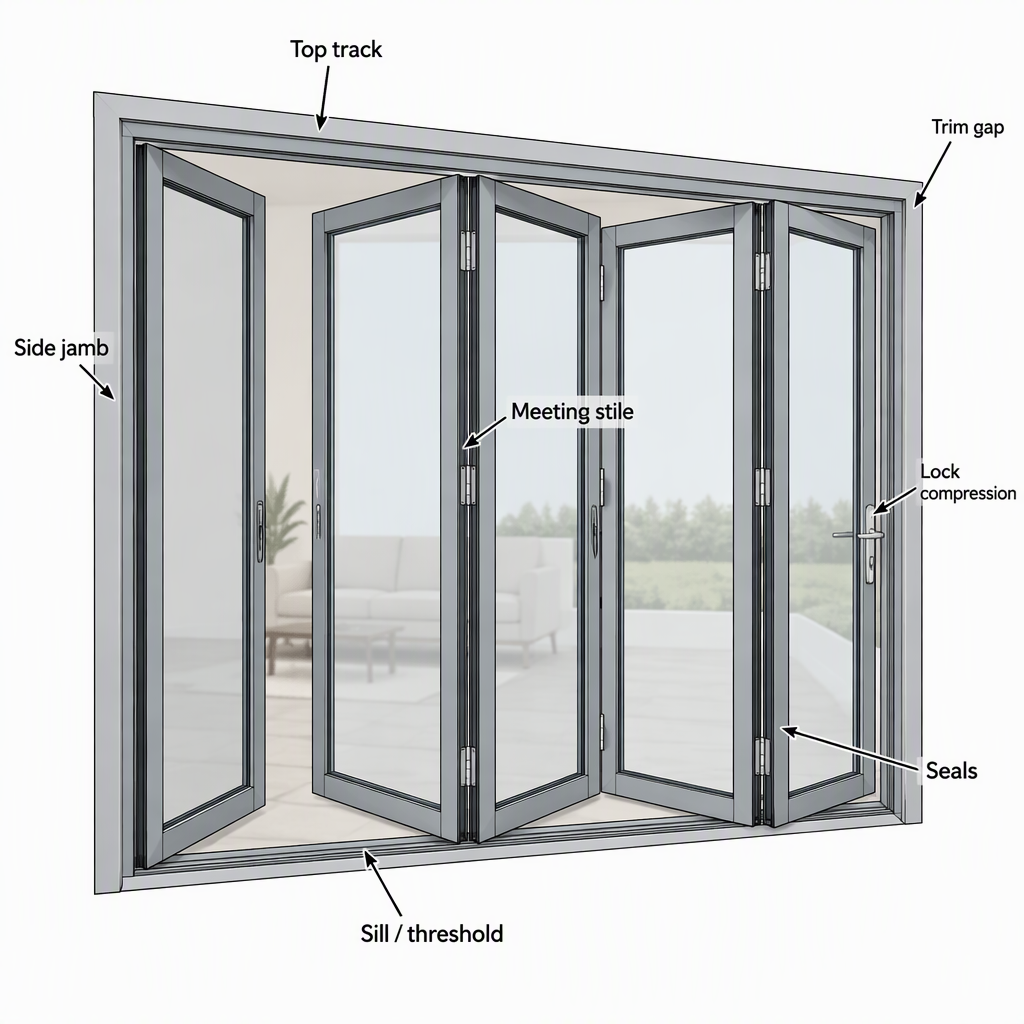
| Symptom | Likely area | What to check |
|---|---|---|
| Whistle near the wall edge | Jamb or trim gap | Look for visible gaps, loose caulk, or air behind trim. |
| Noise between folding panels | Meeting stile, hinge side, or lock compression | Confirm the panels close fully and the lock draws the seals together. |
| Noise at the floor | Track, sill, or threshold | Check for debris, poor seal contact, or a low threshold detail that needs adjustment. |
| Noise after service or installation | Alignment and final adjustment | Review whether frame alignment, smooth operation, sealing, and inspection were completed. |
When installation, alignment, or settling is the issue
A new or recently adjusted bifold door can whistle if the frame, trim, or rough-opening area leaves an air path, even when the panels themselves appear closed.
- Ask whether the frame was checked for alignment and smooth operation after installation or adjustment.
- Inspect fixed trim and perimeter joints separately from moving panel seals; fixed gaps and moving joints need different remedies.
- Confirm hardware compatibility before changing handles, hinges, locks, or seals on an aluminum bifold system.
- If the door binds, drops, rubs, or will not lock evenly, stop treating the issue as a simple caulking job and call the installer.
Why exposure makes some bifold doors whistle more
Wind direction, balcony height, coastal exposure, and driving rain can make a small gap much more noticeable, so exposed openings should be reviewed as complete assemblies rather than as isolated door panels.
| Opening condition | Why the whistle may change | Buyer check |
|---|---|---|
| Coastal or high-wind-facing opening | Site exposure can put more pressure on seals, drainage, finish, fasteners, hardware, glass, and installation interfaces. | Review the exact series evidence for the project location and exposure. |
| Balcony or upper-floor opening | Wind may hit the door at angles that expose small perimeter paths. | Ask how the opening type, drainage, seals, and maintenance access will be handled. |
| Large opening with many panels | More panel joints mean more places that must align and compress correctly. | Confirm operating clearance, hardware layout, glass choice, and installation scope before ordering. |
What you can fix yourself and when to call a pro
You can start with cleaning, observation, and simple fixed-gap sealing, but moving joints, frame movement, hardware compression, and track alignment should be handled according to the door manual or by a qualified installer.
- Clean debris from the track and threshold so the panels can close in their designed position.
- Seal only fixed perimeter gaps that are appropriate for caulk, backer rod, or similar materials.
- Use weather stripping concepts only where they match the door type and do not interfere with folding movement.
- For any manual access to concealed hardware, tracks, or locking parts on powered or motorized accessories, switch off and disconnect the relevant power source first, then follow the model manual’s permitted access steps only.
- Call a professional if the frame is out of square, the panels do not lock evenly, the sill leaks, or the repair would require frame removal.
What to specify if you are choosing aluminum bifold doors
When selecting aluminum bifold doors, specify the opening conditions, operating direction, threshold needs, glass choice, hardware, seals, maintenance access, and installation responsibility before comparing appearance alone.
- Review track solutions, inward or outward folding direction, frame casing options, glass variations, handles, hinges, locking points, and sealing materials on the DERCHI 93 Bifold Door page.
- Use the broader DERCHI aluminum bifold door category to compare customization topics such as sizes, glass, finishes, hardware, sealing, production steps, final adjustment, and inspection.
- For exposed locations, define wind, rain, drainage, finish, fastener, hardware, glass, and installation-interface requirements before choosing a system.
- If privacy matters, handle glass selection as a separate design choice while still checking seal compression, threshold detail, and hardware compatibility.
- Ask the supplier or installer which joints are serviceable, which are fixed perimeter joints, and which must not be sealed after installation.
Conclusion: treat the sound as a leak path, not just a noise
The fastest path to a quieter bifold door is to locate the exact air path first, then match the fix to the gap type.
Weather stripping and sealing can help with drafts when used in the right place, but alignment, exposure, hardware compression, and installation interfaces often need a supplier or installer review.
- Test before replacing parts.
- Keep caulk on fixed joints, not moving seams.
- For exposed openings, specify the whole assembly and installation scope.
Bifold door whistling FAQ
These quick answers cover the most common next decisions after you find a whistling bifold door.
Is a whistling bifold door dangerous?
Not always. It may be a nuisance draft, but visible gaps, poor locking, water entry, frame movement, or a door that will not close squarely should be reviewed by an installer.
Will caulk stop a bifold door from whistling?
Caulk may help at fixed trim or perimeter gaps, but it is not the right fix for moving panel joints, tracks, locks, or seals that need adjustment.
Should I replace the whole bifold door if it whistles?
Diagnose first. Replacement may be considered when the system, hardware, seals, or installation cannot be corrected, but a single draft does not prove the whole door is unsuitable.
Why does the door whistle only in strong wind?
A small air path may stay quiet in calm weather and become audible when wind pressure increases or changes direction across an exposed opening.
Can a low threshold bifold door whistle more easily?
A low threshold detail should be checked for seal contact, drainage, debris, and alignment; do not assume the threshold alone is the cause without testing the full perimeter.
Can glass choice cause the whistle?
Glass choice is usually a specification item, while whistling is more often traced to air paths around seals, tracks, trim, or panel joints; ask the supplier how the chosen glass works with the full door system.
Who should inspect a persistent whistle?
Use the original installer, door supplier, or a qualified door technician, especially when the issue involves alignment, final adjustment, hardware, sealing, or frame movement.


