


When film is the practical path
Film can make sense when the existing sliding glass door is structurally sound, the glass is compatible, and the goal is to reduce heat, glare, or daytime visibility without replacing the door.


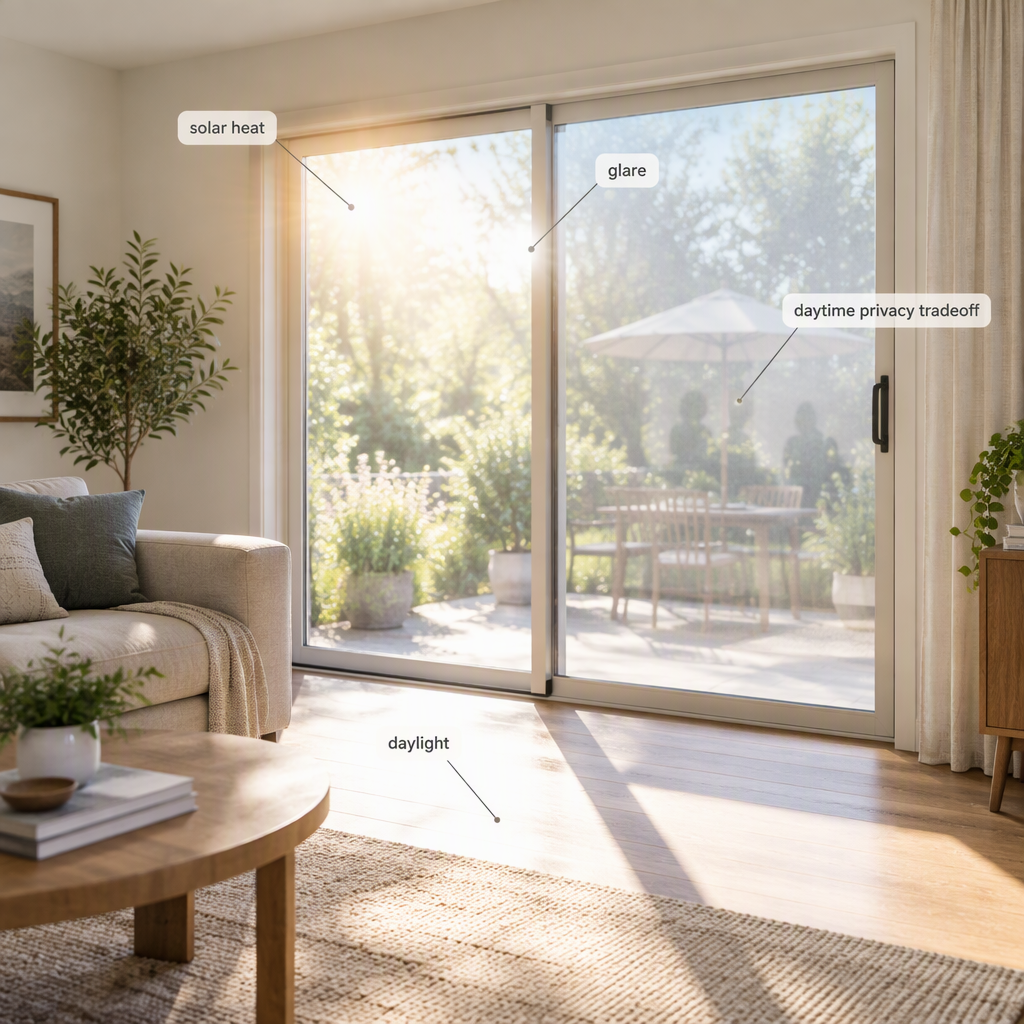
The best tint for a sliding glass door is not simply the darkest film; it is the film that balances lower solar heat gain, enough visible light, the desired privacy level, and the risk profile of the existing glass.
Solar-control window film can reduce solar heat gain by reflecting and absorbing part of the sun’s energy, but that same behavior can increase glass temperature. For a sliding glass door, especially one with insulated glass, that makes product selection and compatibility review more important than color alone.
Two rating terms matter most for everyday decisions: solar heat gain coefficient, or SHGC, and visible transmittance, or VT. Lower SHGC means less solar heat is transmitted through the glass, while higher VT means more visible daylight passes through.
| Goal | What to look for | Tradeoff to check |
|---|---|---|
| Reduce heat from sun | Lower SHGC on the film or glass rating | Very dark or highly absorbing products may need a closer glass-compatibility review. |
| Reduce glare | A film that cuts strong sunlight and reflection | Too much glare control can make the room feel darker. |
| Keep daylight | A VT level that still supports the room’s daylight needs | Higher daylight transmission usually means less daytime privacy. |
| Add daytime privacy | Tinted, reflective, or privacy-oriented film selected for the exposure | Many privacy films work best in daytime and may not provide the same privacy at night when interior lights are on. |
Use NFRC-labeled film data and the same rating terms used for windows and doors, especially SHGC for solar heat and VT for daylight, instead of relying only on words like dark, reflective, ceramic, or privacy.
The National Fenestration Rating Council window-film program states that NFRC independently tests, certifies, and labels window films for energy efficiency. That makes the label a better comparison tool than a product nickname or shade description.
ENERGY STAR explains that fenestration labels use performance terms such as U-factor, SHGC, air leakage, visible transmittance, and condensation resistance. For tint selection, SHGC and VT are usually the first numbers to review because they describe solar heat and visible light.
A sliding glass door should be checked for glass type, insulated-glass construction, age, damage, sun exposure, and warranty terms before film is applied, because film can raise glass temperature and may create thermal-stress or seal concerns.
Sliding glass doors often contain large glass lites. When film changes how the glass absorbs and reflects solar energy, the temperature pattern across the pane can change. NFRC consumer guidance notes that added film can raise glass temperature and may create concerns with thermal stress or insulated-glass seals.
Window tint is not a substitute for required safety glazing; sliding glass doors may be subject to safety-glazing rules, and local code requirements should be verified separately from privacy or solar-control goals.
United States federal safety-glazing rules in 16 CFR Part 1201 address architectural glazing materials used in doors and patio-type sliding glass doors, with the purpose of reducing unreasonable risk of death or serious injury from broken glazing after human contact.
For U.S. federal legal-text context, Cornell Law School’s Legal Information Institute reproduces 16 CFR Part 1201.1. Final project decisions should rely on the official current regulation, adopted local code, and product-specific documentation.
Choose aftermarket film when the existing door is sound and compatible; choose factory tinted glass, Low-E glass, integral blinds, or a replacement sliding door when you need a more integrated privacy, heat-control, warranty, or design solution.
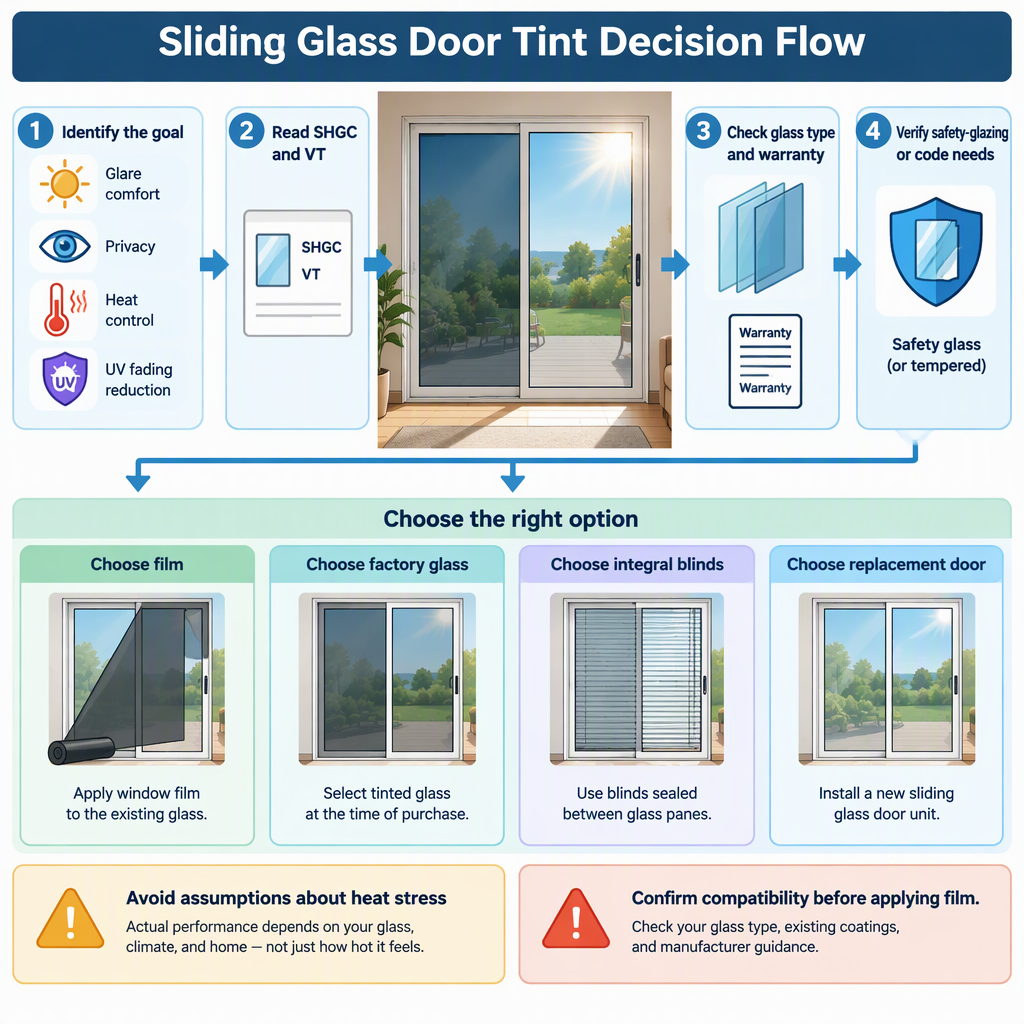
Film is often considered when the door is already installed. Glass and door-system options are usually considered during design, replacement, or major renovation, when the frame, glazing, drainage, sealing, and installation can be evaluated together.
| Option | Best fit | Questions before choosing |
|---|---|---|
| Aftermarket window film | Existing door is in good condition and compatible with the selected film. | Is the film rated, approved for the glass, and acceptable under the door or glass warranty? |
| Factory-tinted or Low-E glass | New construction, replacement, or projects that need a glass specification from the start. | What are the SHGC and VT values for the exact glazing configuration? |
| Integral blinds | Projects needing adjustable privacy without an exposed interior blind on the door face. | Is the blind option available for the selected door model and configuration? |
| Replacement sliding door | Projects where the existing frame, sealing, drainage, or glazing package no longer meets the design goal. | Can the replacement door meet the opening size, performance needs, local code, and installation scope? |
Film can make sense when the existing sliding glass door is structurally sound, the glass is compatible, and the goal is to reduce heat, glare, or daytime visibility without replacing the door.
A system approach may be better when the project also needs improved frame design, insulated glazing, sealing, drainage, installation quality, or a different opening configuration.
DERCHI Q5 and Q9 product pages support discussion of aluminum sliding-door alternatives with insulated glass and optional configurations, but they do not prove that aftermarket film is approved for those doors.
The DERCHI Q5 Series Aluminum Glass Sliding Door page describes a thermal-break aluminum sliding door system with 5+27A+5 insulated glass, 2-track or 3-track frame choices, concealed drainage, and optional blinds.
The DERCHI Q9 Series Slim Frame Aluminum Sliding Door page describes a slim-frame sliding door with 8+21A+8 glass, single-track and two-track options, a barrier-free rail option, and multiple panel configurations.
DERCHI’s energy-efficiency information describes a system approach that combines insulated glazing, thermal-break aluminum frames, sealing, drainage, and installation quality.
| DERCHI page | What it helps evaluate | What it does not prove |
|---|---|---|
| Q5 sliding door | Thermal-break frame, insulated glass, track choices, concealed drainage, and optional blinds for that model page. | Approval for a third-party aftermarket film on every Q5 configuration. |
| Q9 slim-frame sliding door | Slim-frame design, glass make-up, track options, rail option, and panel configurations for that model page. | Film compatibility, safety-code approval, or certified energy results for every market. |
| Energy efficiency page | How DERCHI explains system-level energy design with glazing, frame, sealing, drainage, and installation. | Configuration-specific certification, project savings, or a film recommendation. |
Before approving a tint job, ask the installer to document the glass type, film rating, warranty effect, edge condition, sun exposure, cleaning instructions, and whether the door already uses Low-E, tint, laminated glass, or an insulated glass unit.
Window tint can be a practical upgrade for heat, glare, and daytime privacy, but the safest specification starts with ratings, glass compatibility, warranty review, and code separation rather than color alone.
If the existing sliding glass door is compatible and in good condition, a rated film may solve the immediate comfort or privacy problem. If the project also needs a new glazing package, different opening layout, integrated blinds, thermal-break framing, sealing, drainage, or a cleaner design specification, compare door-system options before choosing film.
For DERCHI sliding-door projects, review the exact Q5 or Q9 product configuration and ask for project-specific glass and warranty guidance before adding a third-party film.
These FAQs answer the recurring questions readers ask after learning the basic tint, heat, privacy, and compatibility tradeoffs.
Yes, in many cases, but the film should be matched to the glass type, insulated-glass construction, sun exposure, condition, and warranty terms before installation.
Solar-control film can reduce solar heat gain, and lower SHGC means less solar heat is transmitted. The actual comfort result depends on the film, glass, exposure, room design, and installation.
No. Darkness describes appearance, while SHGC and VT describe solar heat and visible light performance. Compare rated data instead of choosing only by shade.
Many privacy-oriented films work best when the outside is brighter than the inside. At night, interior lighting can reduce privacy, so curtains, shades, blinds, or integral blinds may still be needed.
Film can increase glass temperature and may create thermal-stress concerns in some conditions. The risk depends on the glass construction, film type, edge condition, shading pattern, and exposure.
Window film is mainly used for solar control, glare, and privacy. It should not be treated as a substitute for an insulated glass unit, thermal-break frame, air-sealing, or a full energy-rated door specification.
No. Tint is not a substitute for required safety glazing. Sliding glass doors may be subject to safety-glazing rules, and the applicable requirement should be verified for the project location.
The available Q5 and Q9 product pages describe their door systems and glass make-ups, but they do not prove approval for third-party aftermarket film. Ask for guidance for the exact configuration before applying film.


