


Clear glass
Useful where visibility and daylight matter more than privacy, such as between social spaces or display areas.


A sliding pocket door is a good choice when you need to save floor space, but only if the wall can safely hide the moving panel, track support, guides, and serviceable hardware. Check the cavity, opening clearance, privacy needs, and future maintenance access before the wall is closed.
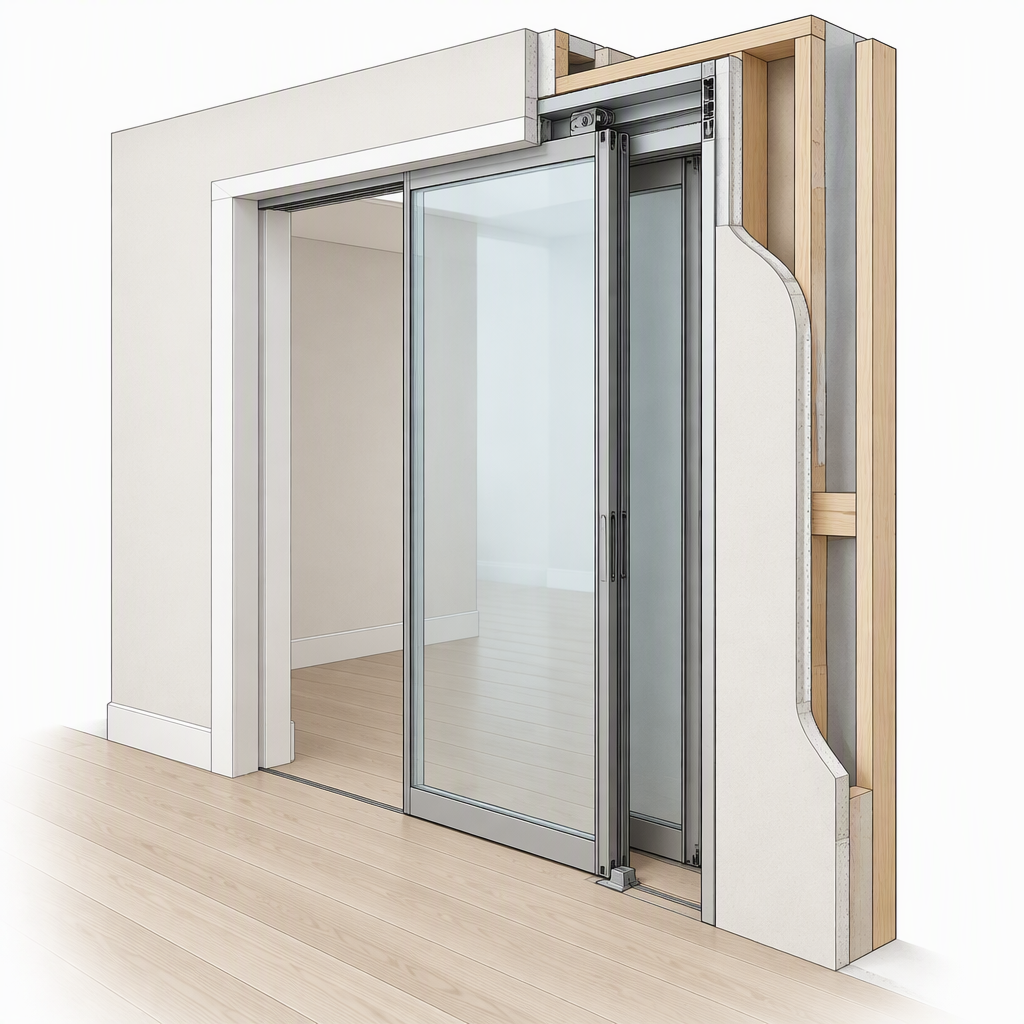
A pocket door needs more than an open doorway: the wall must provide a clean pocket, structure for the track, room for the panel, and access for future adjustment, so the cavity should be checked before framing closes.
Pocket, surface sliding, bifold, and swing doors solve different clearance problems; choose the layout that matches wall space, swing space, privacy needs, and maintenance access rather than choosing by style alone.
| Layout | Best fit | Main planning check | Maintenance access |
|---|---|---|---|
| Pocket sliding door | Rooms where floor swing clearance is limited and a wall cavity can be planned | Wall pocket, track support, clear opening, and concealed hardware access | Service points must remain reachable after the wall is finished |
| Surface sliding door | Projects where the wall cannot hide a panel but side wall space is available | Clear wall run beside the opening and safe panel travel | Track and rollers are typically easier to inspect because they are not hidden in a pocket |
| Bifold door | Wider openings where panels can fold to one or both sides | Panel stack area and floor/track details | Hinges, pivots, and guides need clear access for adjustment |
| Swing door | Openings where a hinged leaf has enough arc clearance | Swing path, furniture layout, and handle clearance | Hinges, latch, and closer hardware are usually exposed and simple to reach |
If you are comparing DERCHI sliding systems, the DERCHI sliding door category is a useful starting point for product navigation, while final fit still depends on the exact series and project drawings.
For accessible routes in the United States, sliding and folding door clear width is measured to the leading edge, and compliant projects must also consider maneuvering clearance, thresholds, hardware height, and operable force.
The U.S. Access Board ADA door and gate guide explains how accessibility requirements apply to doors and gates, including clear width measurement for sliding and folding doors, maneuvering clearances, threshold limits, hardware operation, and opening-force guidance where the ADA Standards govern the project.
| Planning item | Why it matters | What to verify |
|---|---|---|
| Clear opening | A door that looks wide enough may not provide the required usable passage once the leading edge is considered. | Measure the clear opening using the rule that applies to the project jurisdiction. |
| Maneuvering clearance | Users need space to approach, operate, and pass through the door. | Confirm approach-side and pull/push-side space with the applicable accessibility standard or code official. |
| Threshold | Raised or abrupt thresholds can block accessible movement. | Check allowed height, bevel, and transition requirements before selecting floor details. |
| Hardware | Accessible doors need operable hardware that can be used without tight grasping, pinching, or twisting where ADA rules apply. | Select pulls, locks, and operating parts that match the applicable standard and the user group. |
Glass pocket doors can borrow light and make rooms feel larger, but privacy depends on the glass choice, door location, and what the room is used for; do not rely on unsupported add-ons such as curtains, film, or blinds unless they are separately specified.
Useful where visibility and daylight matter more than privacy, such as between social spaces or display areas.
Better for bathrooms, bedrooms, offices, or mixed-use rooms where light is welcome but direct visibility is not.
Good when the project needs a defined aluminum frame, stable panel guidance, and a clean modern look.
Consider another layout or panel style if sound separation, full privacy, or exterior exposure is more important than borrowed light.
A pocket door works well only when rollers, guides, pulls, locks, and stops remain reachable for adjustment or replacement; inaccessible hardware can turn a minor alignment issue into wall repair.
A practical maintenance plan is simple: keep track and guide areas clean, watch for rubbing or panel sway, avoid forcing a misaligned panel, and keep access points open for adjustment; service intervals should come from the actual hardware supplier or installer.
Pocket layouts are usually better protected indoors; exterior-facing openings need weather, drainage, threshold, wind, water, and local-code review using the exact system and configuration.
| Opening condition | Better question to ask | Likely next step |
|---|---|---|
| Interior room divider | Can the wall hide the panel and keep service access? | Review pocket layout drawings and hardware access with the installer. |
| Covered patio or semi-exposed area | Will the system handle the actual exposure, drainage, and threshold condition? | Request project-specific confirmation before selecting a pocket layout. |
| Exterior wall opening | What tested door system and local code path apply? | Compare exterior-rated sliding systems and obtain code review for the jurisdiction. |
The WT-103 page supports using WT-103 as an example of a DERCHI ultra-narrow sliding system with pocket and ghost layout variants, but it should not be stretched into unsupported claims about compliance, approvals, lead time, or performance in every project.
DERCHI presents the WT-103 sliding and sling door as an ultra-narrow aluminum sliding system with pocket door and ghost door layout variants. Use that product page as a starting point for configuration discussion, then confirm drawings, glass, hardware, opening size, and jurisdictional requirements for the actual project.
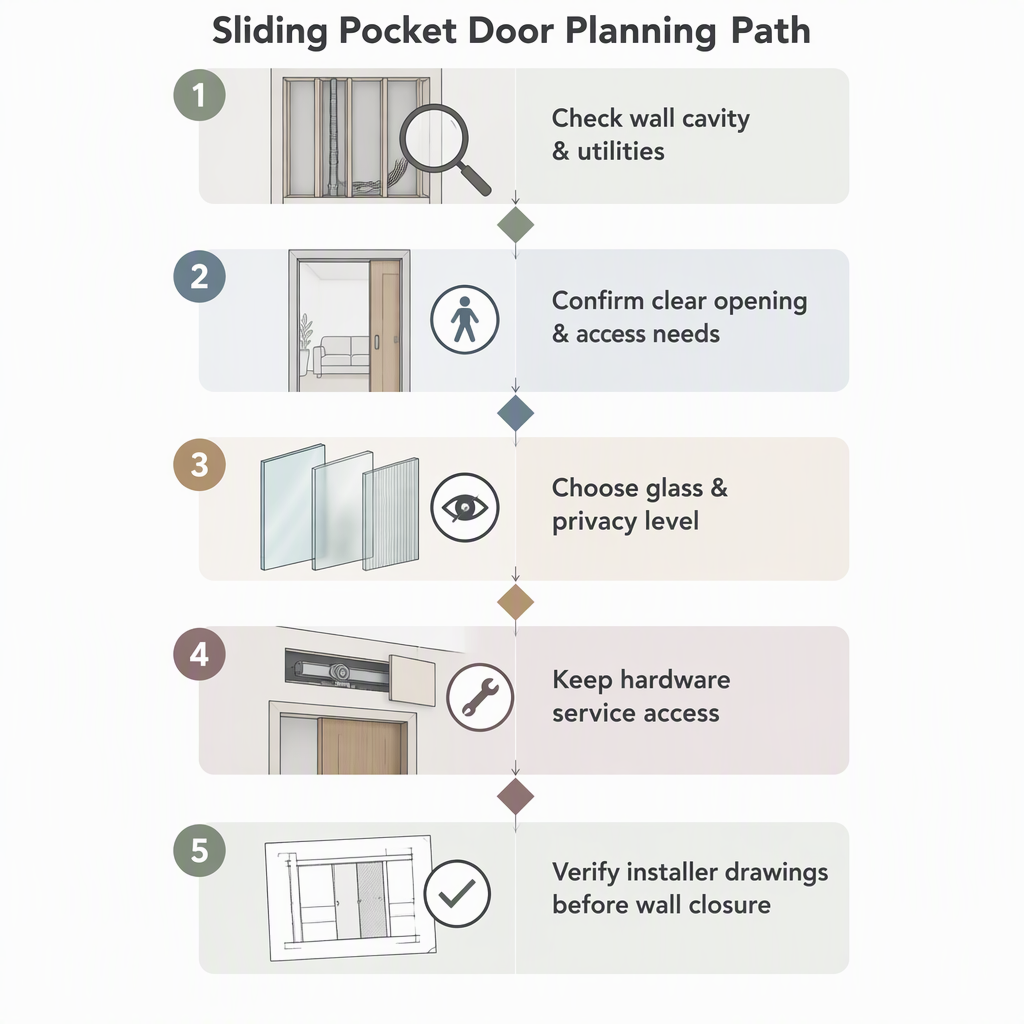
Before ordering, confirm wall cavity feasibility, opening measurements, glass and privacy needs, hardware accessibility, jurisdictional code requirements, and whether the installer has the system-specific drawings.
A sliding pocket door can solve a space problem, but the best time to make the decision is before the wall is built. If the cavity, clearance, privacy, and maintenance plan are not clear, compare a surface sliding, bifold, or swing layout before committing.
These FAQs answer the common planning questions that remain after checking wall cavity, clearance, accessibility, privacy, hardware, and maintenance limits.
A pocket door saves swing space because the panel slides into the wall instead of opening across the floor area.
Check the pocket space, structure, utilities, track support, panel travel, and future access to hardware before the wall is closed.
No. Where ADA rules apply, the project still has to address clear width, maneuvering clearance, thresholds, hardware operation, and other applicable requirements.
It can be private if the glass type and room location support that goal, but privacy should be specified as part of the door and glazing decision.
Rollers, guides, stops, pulls, and locks may need adjustment over time, and hidden hardware is harder to service if access was not planned.
Do not assume so. Exterior openings need weather, drainage, threshold, wind, water, security, and code review for the exact system and configuration.
DERCHI’s WT-103 product page presents pocket door and ghost door layout variants for that system, but final suitability depends on the project drawings and configuration.
Use the hardware supplier’s or installer’s instructions for service intervals. In day-to-day use, keep guide areas clean and respond quickly to rubbing, dragging, or misalignment.


