


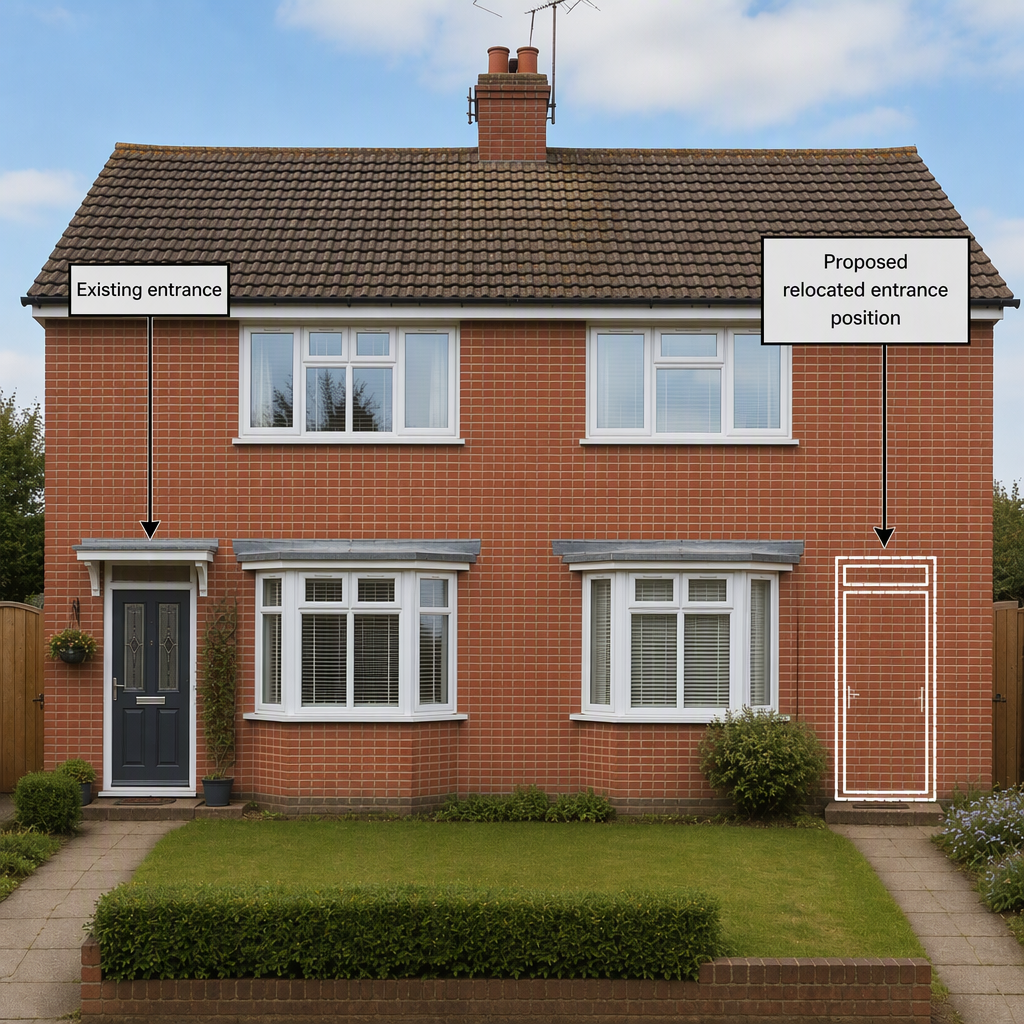
UK jurisdiction checks: England, Wales, Scotland and Northern Ireland
There is no safe single shortcut for every UK home: use the UK-wide question as a prompt to check the correct local route before ordering or starting work.
| Where the home is | What the public planning route means for your project | Practical next step |
|---|---|---|
| England | Door and window planning guidance says similar-appearance repairs, maintenance and minor improvements are usually lower risk, subject to exceptions. | Check permitted-development limits, Article 4 Directions and previous planning conditions before relying on permitted development. |
| Wales | GOV.UK gives general England-and-Wales guidance to contact the local planning authority when checking whether permission is needed. | Ask the local planning authority for the project-specific answer, especially if the door is moving rather than being replaced in the same opening. |
| Northern Ireland | nidirect says homeowners should ask the council planning office before starting development work, and designated or listed settings can restrict permitted development. | Use the council planning office as the first planning checkpoint. |
| Scotland | Do not apply England-only door-planning or Building Regulations statements as Scottish rules. | Use a separate Scottish local planning and building-standards check before committing to the new entrance position. |
For England and Wales, GOV.UK also warns that unauthorised work can lead to enforcement action.
This guide is general information for planning a project. It is not legal advice, and it cannot replace written project-specific advice from the relevant authority or professional adviser.
When permission is usually not needed
In England, a same-opening replacement front door is usually lower risk for planning when the new door is similar in appearance to the existing house, but you should still check local restrictions.
| Project situation | Planning risk in England | Buyer action |
|---|---|---|
| Repairing, maintaining or replacing a door with a similar appearance | Usually lower risk | Keep photos and notes showing the existing opening, door appearance and chosen replacement. |
| Inserting doors or windows of similar appearance to those used in the house construction | Often not a full planning-application issue | Check whether special controls apply before you buy. |
| Work relying on permitted development rights | Conditional | Confirm that every relevant limit and condition is met. |
For England, the Planning Portal doors and windows guidance says repairs, maintenance, minor improvements and similar-appearance door or window changes are usually outside planning permission, subject to exceptions.
Why moving the door is different from replacing it
Moving the front door can change the building and the way it is entered, so it should be treated differently from replacing a door in the same opening.
| Same-opening replacement | Relocated front door |
|---|---|
| Often assessed as repair, maintenance or minor improvement in England when appearance is similar. | May form part of a larger change to the dwelling, its elevation or use of access. |
| Survey work focuses on the existing frame, threshold, weathering, glazing and compliance route. | Survey work also needs the old opening, new opening, structure, approach path, privacy impact and making-good work. |
| The planning question is often simpler. | Permitted-development limits, earlier planning conditions or Article 4 Directions may matter. |
Do not assume “permitted development” means “no checks.” The GOV.UK householder permitted development guidance explains that permitted development rights apply only when the relevant limits and conditions are met, and local restrictions can remove rights.
Restricted properties and local rules to check
The answer can change if the home is listed, in a designated area, affected by an Article 4 Direction, subject to leasehold controls or covered by earlier planning conditions.
- Check whether the property is listed or in a conservation area or other designated area.
- Ask whether an Article 4 Direction or a previous planning condition removes permitted development rights.
- If the home is leasehold, check the lease and any landlord or management-company consent route.
- In Northern Ireland, ask the council planning office before starting development work, especially in listed or designated settings.
- For England and Wales, use the local planning authority as the project-specific planning checkpoint.
If the new front door affects a protected frontage, a flat, a converted building, a shared access route or a property with planning history, get the authority check in writing before ordering materials.
Building Regulations may still apply
In England, even when planning permission is not needed, replacement external doors can still be controlled fittings under Building Regulations, so thermal performance, glazing, ventilation, fire safety, escape, access and threshold details may need review.
- In England, confirm the required thermal-performance route for the replacement external door.
- In England, check whether any glazing needs safety-glass specification.
- In England, review ventilation, fire-safety and means-of-escape implications before changing the entrance layout.
- For a main entrance in an English dwelling built since 1999, consider whether a level threshold must be maintained.
- In England, ask whether the work needs Building Control notification or can be handled by a relevant Competent Person Scheme installer.
GOV.UK building-work guidance for England says replacement windows or doors may need notification to a Building Control Body unless completed through a relevant Competent Person Scheme, and certificates can matter when the home is sold.
Build a UK opening brief before you order
Before choosing a relocated or replacement entrance door, prepare a brief that separates planning checks, Building Regulations or local equivalents, product choice, survey responsibility, delivery and on-site installation scope.
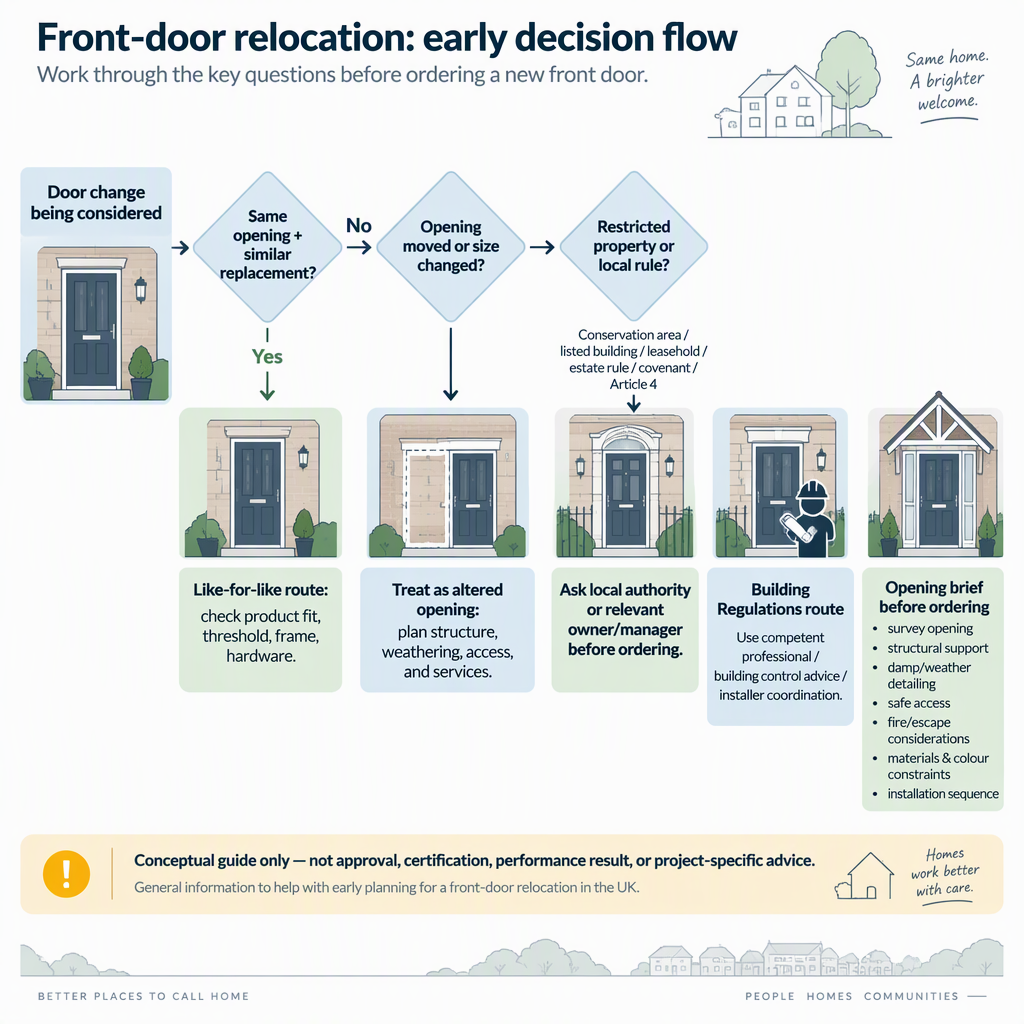
- Identify the local planning authority or council route before committing to the new opening position.
- Where England Building Regulations guidance applies, record the existing opening, proposed opening, threshold, escape route and access route for discussion.
- Set out the project location, opening type, approximate size, quantity and target timing for supplier discussions.
- Assign who is responsible for local survey, drawing approval, delivery or import arrangements and on-site installation.
- In England, confirm who will provide any required Building Control notification or completion certificate.
If you are defining a UK aluminium door package, prepare the location, opening sizes, quantities, timing and responsibility split before discussing options.
Discuss a UK opening briefDesign factors for the new front door position
Once the planning route is being checked, test the door choice against the new opening layout, operating clearance, glazing, hardware, exposure, privacy, maintenance and installation scope.
| Design factor | Why it matters when the door moves |
|---|---|
| Opening layout | The supplier and survey team need the opening type and approximate size before drawings or package scope are agreed. |
| Operating clearance | In England-focused Building Regulations guidance, swing, threshold and access details can affect access and escape review. |
| Glazing and privacy | In England, glazed areas may need safety-glass review; in any location, the new position may also change privacy from the street. |
| Hardware compatibility | DERCHI describes hidden-hinge entry-door positioning and hardware options on its thermal break entry door page, but project suitability must be checked for the selected configuration. |
| Weather exposure | Moving the entrance can change exposure to wind-driven rain, sun and doorstep drainage, so survey the new frontage rather than copying the old door detail. |
| Maintenance access | Door material, glass and hardware choices should be practical to clean, inspect and maintain at the new location. |
- Review thermal break entry door options only after the opening and compliance route are clear.
- Use DERCHI’s front entry door range as a style and configuration reference, not as proof of local approval.
- Ask the designer or installer to confirm handing, frame depth, sill detail, drainage, fixing background and making-good work.
Who to contact before work starts
Start with the planning authority or council route, then confirm the building-control route for the relevant nation, then finalise survey, product and installation responsibilities.
- For England and Wales, ask the local planning authority whether the proposed front-door move needs permission.
- For Northern Ireland, ask the council planning office before starting development work.
- For Scotland, use a separate Scottish local planning and building-standards check rather than relying on England-only guidance.
- Ask about listed-building status, designated areas, Article 4 Directions and earlier planning conditions where those checks are relevant.
- In England, confirm whether the installer can use a relevant Competent Person Scheme route or whether a Building Control Body must be notified.
- Give the supplier a clear opening brief so product discussions do not get confused with legal approval or site certification.
Risks of starting without permission or approval checks
Starting first and checking later can leave you exposed to planning enforcement, approval problems, delay, extra cost and missing paperwork when you sell.
For England and Wales, GOV.UK warns that unauthorised work can lead to enforcement action.
For England, GOV.UK says Building Regulations non-compliance can be illegal and that completion certificates may matter when selling a home.
Conclusion
The safest practical answer is to check before you move the door, even if a similar replacement in the same opening would usually be simpler.
For many homes in England, a similar replacement front door may be straightforward, but relocating the opening adds planning, access, Building Regulations and responsibility questions.
Prepare the authority check, opening brief and installation scope before choosing the door package, and keep England-only Building Regulations guidance separate from checks needed in Scotland, Wales or Northern Ireland.
FAQs about moving a front door in the UK
These quick answers help you separate planning permission, England-focused Building Regulations guidance and door-ordering decisions before work starts.
Do I need planning permission to move my front door?
You may need it, because moving the opening can be more than a simple replacement. For England and Wales, ask the local planning authority before work starts.
Is replacing a front door in the same opening different?
Yes. In England, repairs, maintenance and similar-appearance replacement doors are usually lower risk for planning than moving the opening.
Can Building Regulations apply even without planning permission?
In England, yes. External replacement doors can be controlled fittings, and issues such as thermal performance, safety glazing, access and escape may still apply.
What if my home is listed or in a conservation area?
Treat it as a stop-and-check situation. Listed buildings, designated areas and local restrictions can change the permission route.
Is Northern Ireland handled the same way as England?
Do not assume so. nidirect advises homeowners to ask the council planning office before starting development work.
What should I do if the property is in Scotland?
Do not rely on the England-only planning or Building Regulations points in this guide. Use a separate Scottish local planning and building-standards check before ordering or starting work.
Should I order the new door before asking the council?
It is better to prepare measurements and a brief first, but avoid committing to final product, delivery and installation scope until the authority and building-control route is clear.
What information should I give a door supplier?
Give the project location, opening type, approximate size, quantity, timing and responsibility split for survey, drawings, delivery and on-site work.


